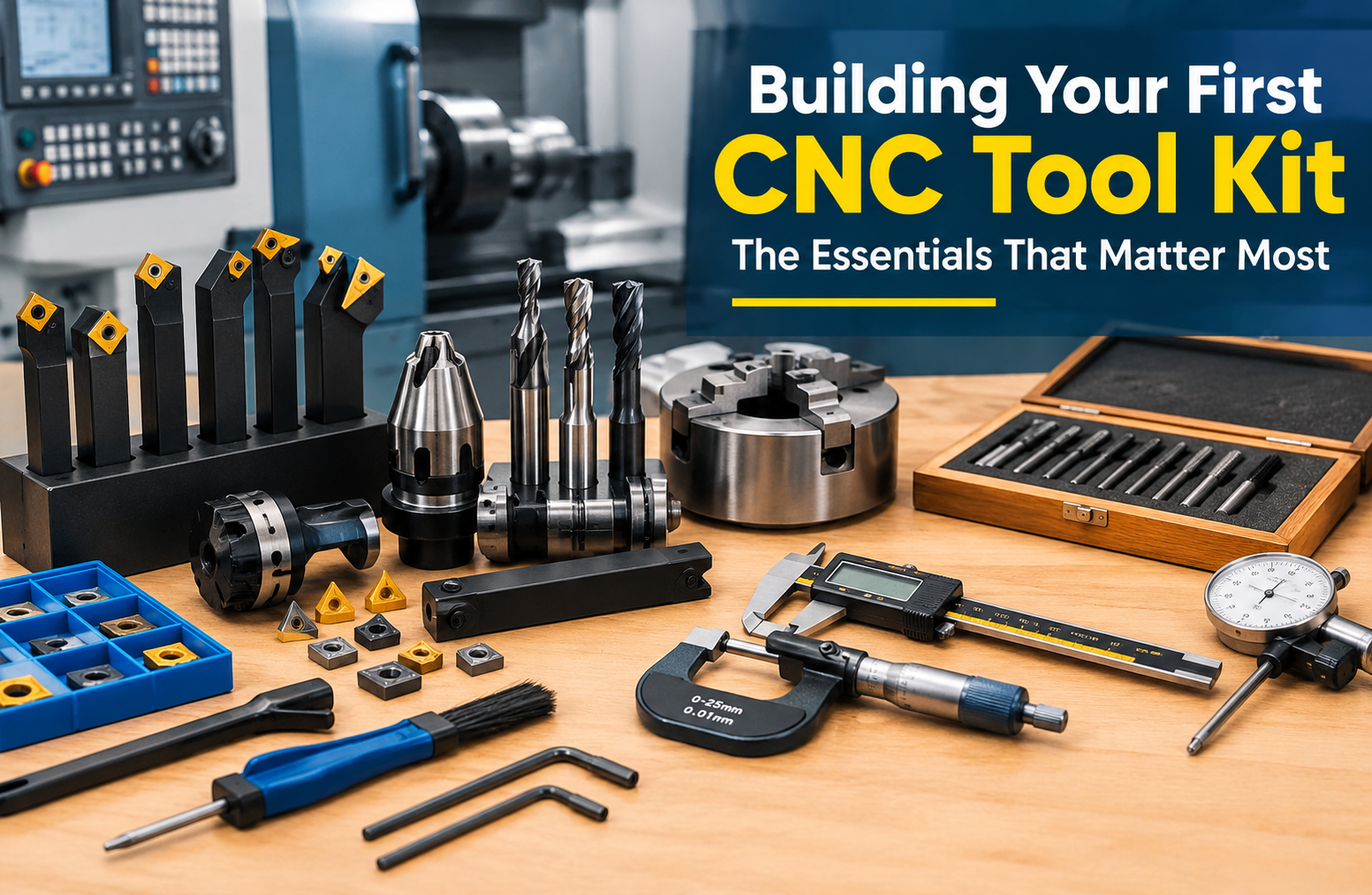
Building Your First CNC Tool Kit: The Essentials That Matter Most
Building your first CNC tool kit can feel more complicated than it needs to be. There are hundreds of cutting tools, measuring devices, holders, accessories, and specialty products available, and beginners can easily assume they need all of them before starting their first machining project.
In reality, a good beginner tool kit should focus on versatility. The goal is to have a small group of dependable tools that can handle common machining tasks while helping you learn proper setup, cutting, and inspection habits. As your experience grows, you can add more specialized equipment based on the materials and parts you work with most often.
For anyone learning turning operations, a basic selection of lathe tools can provide a strong foundation. Turning tools allow machinists to face material, reduce diameters, create shoulders, cut grooves, and complete many of the operations needed to produce cylindrical parts.
Your first tool kit should also include practical measuring equipment. Accurate machining depends on more than what happens inside the CNC machine. You need reliable ways to confirm that stock dimensions, finished features, and setup positions match the specifications of the job.
Starting with the essentials makes it easier to understand what each tool contributes to the machining process before investing in more advanced equipment.
Must-Have Tools for Your First Machining Projects
The first thing to think about when building a CNC tool kit is the type of work you expect to perform. Milling and turning require different cutting tools, but the same general principle applies: begin with tools that can perform multiple common operations.
For lathe work, beginners should become familiar with basic turning tools and inserts. A general-purpose turning tool can remove material from the outside diameter of a workpiece, while facing tools help create flat surfaces at the end of the part.
Grooving and parting tools are also useful additions. A grooving tool can create narrow channels or relief features, while a parting tool is designed to separate a finished component from the remaining stock.
Threading tools may become important as projects become more advanced. However, beginners do not necessarily need every possible insert style or holder immediately. It is often better to learn a few basic turning operations well before expanding into specialized tooling.
Tool holding is another important part of the kit. The cutting tool must remain secure and rigid while the machine is running. Poor tool holding can contribute to vibration, inconsistent dimensions, and poor surface finishes.
Beginners should become familiar with proper tool installation and tool stickout. Extending a cutting tool farther than necessary can reduce rigidity and increase the chances of chatter. Keeping the setup as stable as possible can improve both tool performance and finished part quality.
Workholding deserves attention as well. The workpiece must remain secure throughout the machining process. On a lathe, that may involve a chuck, collet, or another workholding method suited to the part geometry.
Before starting a program, machinists should always confirm that the workpiece is properly clamped and that the cutting tool has enough clearance to complete the operation safely.
Basic shop accessories can also make a beginner tool kit more useful. Deburring tools, brushes, chip removal tools, and appropriate hand tools can help with setup and cleanup. These items may not seem as important as cutting tools, but they can make everyday machining much easier.
The best first tool kit is not necessarily the largest one. It is the one that gives you enough flexibility to complete common operations while reinforcing good machining habits.
As you complete more projects, you will naturally discover which additional tools are worth adding. Rather than buying everything at once, expand the kit based on actual machining needs.
Simple Measuring Gear That Helps Avoid Costly Mistakes
Cutting tools may shape the part, but measuring tools tell you whether the process is working correctly. Inspection should be treated as an essential part of CNC machining, especially when you are still learning.
One of the most practical tools for a beginner is a set of dial calipers. Calipers can measure outside dimensions, inside dimensions, depths, and steps, which makes them useful for a wide variety of everyday inspection tasks.
For example, a beginner may use calipers to confirm the diameter of raw stock before machining. After a turning operation, the same tool can be used to check whether the finished diameter is close to the programmed value.
Good measuring technique matters just as much as owning the tool. Measuring surfaces should be clean, and chips or coolant residue should be removed from the workpiece before taking a reading. Even small pieces of debris can affect measurements.
Consistency is important too. Applying too much pressure can produce different readings, so machinists should practice using the same light measuring force each time.
As tolerances become tighter, other measuring tools may be necessary. Micrometers can provide more precise measurements for certain dimensions, while indicators can help verify alignment or movement.
Beginners should learn when each tool is appropriate rather than assuming one measuring device can handle every inspection task.
Another important concept is checking parts throughout the machining process. Waiting until an entire run is finished before measuring can turn a small setup problem into a much larger issue.
Checking the first part early gives you the opportunity to adjust offsets or investigate unexpected dimensions before producing additional pieces.
A height gauge can become another useful addition as your inspection skills grow. Height gauges are commonly used on a surface plate to measure or compare vertical dimensions and can help with layout or inspection work where consistent reference points are important.
For beginners, learning how to establish a reliable reference is one of the most valuable inspection skills. Every measurement depends on understanding where the dimension begins and ends.
This same principle applies inside the CNC machine. Tool offsets, work offsets, and programmed positions all rely on accurate reference points. When those references are incorrect, even a perfectly written program can produce the wrong dimensions.
A good measuring routine should therefore begin before machining starts. Confirm the raw stock size, verify the setup, and make sure the correct tools are loaded. During machining, inspect critical dimensions as soon as practical.
After the part is complete, perform a final inspection of the features that matter most.
Keeping simple notes can also help beginners improve. Record the programmed dimension, the actual measurement, and any offset adjustment that was needed. Over time, this can help you recognize patterns in tool wear, machine behavior, and setup accuracy.
The more comfortable you become with inspection, the easier it becomes to troubleshoot machining problems. If a dimension is incorrect, you can begin narrowing down whether the cause is tool wear, an offset problem, workholding movement, or another setup issue.
Conclusion
Building your first CNC tool kit is less about collecting as many tools as possible and more about choosing equipment that supports the fundamentals of machining.
A small selection of versatile cutting tools can handle many early turning operations, while proper tool holding and workholding help create a stable machining setup. Basic shop accessories make everyday tasks easier and help keep the work area organized.
Measuring equipment is just as important. Calipers provide a practical starting point for common dimensional checks, while more specialized tools can be added as projects and tolerances become more demanding.
The most valuable tool kit is one that grows along with your skills. Start with the tools you need for the work in front of you, learn how to use them correctly, and expand your collection only when new projects require it.
By focusing on reliable cutting tools, accurate measuring equipment, and consistent inspection habits, beginners can build a CNC tool kit that supports better parts, fewer mistakes, and stronger machining skills from the very beginning.