Denver Nuggets vs Houston Rockets Match Player Stats
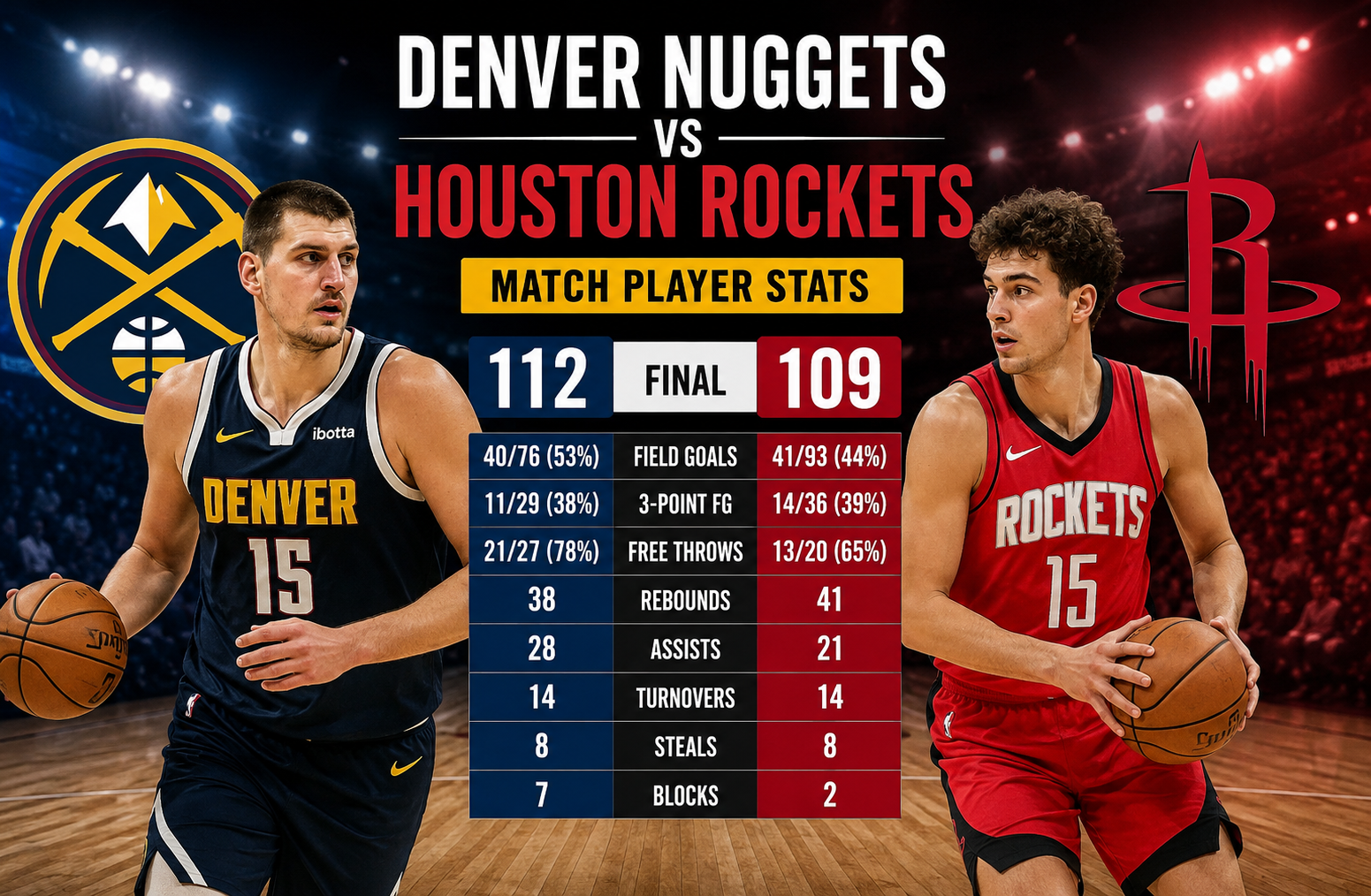
The denver nuggets vs houston rockets match player stats from the November 2025 NBA Cup meeting tell a much deeper story than the final 112-109 score suggests. Denver survived a dramatic Houston comeback at Toyota Center, with Nikola Jokic producing 34 points, 10 rebounds and 9 assists while Jamal Murray added 26 points and 10 assists. Houston received a career-best 27 points from Reed Sheppard, along with 22 from Amen Thompson and 21 from Jabari Smith Jr., but Denver’s late-game execution proved decisive.
The game was played at Toyota Center in Houston during NBA Cup Group Play. Official NBA records identify the contest as Friday, November 21, 2025, with the game recap published on November 22. Denver finished with a 112-109 victory. The Nuggets led 25-12 after the first quarter, Houston answered with a 37-21 second quarter, and the teams then traded high-level offensive stretches before Denver closed the game.
This was not simply a story about Jokic scoring more than everyone else. The box score shows how Denver’s passing, shooting efficiency, late-game decision making and ability to generate efficient possessions helped offset Houston’s rebounding advantage and outstanding three-point shooting.
Denver Nuggets vs Houston Rockets Match Player Stats: Complete Game Overview
The most useful way to understand this matchup is to begin with the team-level numbers.
| Category | Denver Nuggets | Houston Rockets |
| Final Score | 112 | 109 |
| Field Goals | 40-76 | 41-93 |
| Field Goal % | 53% | 44% |
| Three-Pointers | 11-29 | 14-36 |
| Three-Point % | 38% | 39% |
| Free Throws | 21-27 | 13-20 |
| Free Throw % | 78% | 65% |
| Rebounds | 38 | 41 |
| Assists | 28 | 21 |
| Turnovers | 14 | 14 |
| Steals | 8 | 8 |
| Blocks | 7 | 2 |
| Offensive Rebounds | 11 | 18 |
| Defensive Rebounds | 27 | 23 |
| Personal Fouls | 20 | 22 |
One of the biggest statistical differences was shooting efficiency.
Houston actually made one more field goal than Denver, 41 compared with 40. However, the Rockets needed 93 attempts to reach that total, while Denver needed only 76. That difference explains why the Nuggets finished with a 53% field-goal percentage compared with Houston’s 44%.
Denver also made 21 free throws on 27 attempts. Houston reached the free-throw line less effectively, converting 13 of 20.
The Rockets did have clear advantages. They collected 41 rebounds to Denver’s 38 and grabbed 18 offensive rebounds. That second-chance production kept Houston within striking distance throughout the second half.
The Nuggets, however, generated seven more assists and five more blocks. Those numbers help explain how Denver maintained control despite Houston’s offensive rebounding advantage.
Nikola Jokic Delivered the Defining Performance
Nikola Jokic was the most influential player on the floor.
His final line was:
| Nikola Jokic | Stat |
| Minutes | 39 |
| Points | 34 |
| Field Goals | 11-20 |
| Three-Pointers | 4-8 |
| Free Throws | 8-10 |
| Rebounds | 10 |
| Assists | 9 |
| Turnovers | 4 |
| Steals | 2 |
| Blocks | 2 |
The combination of 34 points, 10 rebounds and 9 assists demonstrates why looking only at scoring would undersell his performance.
Jokic was one assist away from a triple-double, but the bigger story was his efficiency. He shot 11-for-20 from the field and made four of eight three-point attempts.
He also became particularly important after halftime.
Houston had taken a 49-46 lead into halftime after its 37-point second quarter. Instead of allowing the momentum to continue, Denver responded through Jokic’s scoring and playmaking.
According to the game recap, Jokic scored 24 of his 34 points in the second half. His third-quarter scoring was especially important as Denver regained control of the game.
This is a key lesson from the player statistics. A box score does not always show when a player’s production arrived. Thirty-four points spread evenly across four quarters would tell a different story from 34 points with 24 coming after halftime.
Jokic’s scoring arrived when Denver needed an offensive response.
Jokic’s Shooting Efficiency Mattered
Jokic attempted 20 field goals and made 11, giving him a 55% field-goal rate from the field.
His four made three-pointers were also significant because Houston could not simply defend him as a traditional interior scorer.
When a center can score efficiently around the basket while also threatening from outside and creating opportunities for teammates, the defensive problem becomes much more complicated.
That complexity was reflected in Denver’s 28 team assists.
Jamal Murray Added a Complete Backcourt Performance
Jamal Murray provided the second major offensive performance for Denver.
| Jamal Murray | Stat |
| Minutes | 41 |
| Points | 26 |
| Field Goals | 10-16 |
| Three-Pointers | 3-7 |
| Free Throws | 3-4 |
| Rebounds | 2 |
| Assists | 10 |
| Turnovers | 4 |
| Steals | 1 |
| Blocks | 1 |
Murray’s 26 points came on 10-for-16 shooting, which is an excellent 62.5% conversion rate from the field.
But his 10 assists may have been even more important.
Denver therefore had two players producing major offensive numbers while also creating opportunities for teammates. Jokic nearly recorded a triple-double, while Murray actually completed a double-double with 26 points and 10 assists.
That combination gave Houston a difficult defensive problem.
If Houston focused heavily on Jokic, Murray could attack.
If the Rockets tried to pressure Murray, Jokic could create from the middle of the floor.
The numbers show that this two-player offensive engine was a major reason Denver scored 112 points despite Houston winning the offensive-rebounding battle.
Reed Sheppard Was Houston’s Breakout Performer
For Houston, Reed Sheppard was arguably the most surprising statistical standout.
| Reed Sheppard | Stat |
| Minutes | 37 |
| Points | 27 |
| Field Goals | 9-13 |
| Three-Pointers | 5-8 |
| Free Throws | 4-6 |
| Rebounds | 0 |
| Assists | 4 |
| Turnovers | 1 |
| Steals | 2 |
Sheppard led all Houston scorers with 27 points.
More importantly, he was extremely efficient.
He shot 9-for-13 from the field and 5-for-8 from three-point range. That gave him a 69.2% field-goal rate and a 62.5% three-point rate.
His performance was especially important during Houston’s second-quarter surge.
The Rockets scored 37 points in the second quarter after managing only 12 in the opening period. Sheppard’s shot-making helped completely change the game’s rhythm.
His five made three-pointers were also a major reason Houston was able to stay within three points at the final buzzer.
Why Sheppard’s Performance Stands Out
A 27-point performance is impressive by itself, but context makes it more meaningful.
Sheppard did not need a huge number of attempts. He converted 9 of 13 field goals.
He also committed only one turnover.
That is important because Houston finished with the same number of turnovers as Denver, 14. Sheppard’s individual ball security therefore helped compensate for some of the Rockets’ overall offensive inefficiency.
His performance demonstrated that Houston had a reliable scoring option beyond its established stars.
Amen Thompson Provided Two-Way Production
Amen Thompson also had a strong game.
| Amen Thompson | Stat |
| Minutes | 43 |
| Points | 22 |
| Field Goals | 10-18 |
| Three-Pointers | 1-2 |
| Free Throws | 1-1 |
| Rebounds | 7 |
| Assists | 2 |
| Turnovers | 3 |
| Steals | 2 |
Thompson scored 22 points while making 10 of 18 field-goal attempts.
His 7 rebounds and 2 steals added value beyond scoring.
He also played 43 minutes, the highest total among the listed players from either team. That workload illustrates how heavily Houston relied on him during a close game.
The concern from Houston’s perspective is that Thompson’s strong production was not enough to overcome Denver’s efficiency.
Houston had four players reach at least 21 points, yet still lost.
That tells us something important about this matchup: Denver’s advantage came from the quality and efficiency of its possessions rather than simply having more individual scorers.
Jabari Smith Jr. Nearly Changed the Ending
Jabari Smith Jr. delivered another strong statistical performance.
| Jabari Smith Jr. | Stat |
| Minutes | 37 |
| Points | 21 |
| Field Goals | 7-20 |
| Three-Pointers | 5-11 |
| Free Throws | 2-3 |
| Rebounds | 11 |
| Assists | 4 |
| Turnovers | 3 |
| Personal Fouls | 6 |
Smith recorded a double-double with 21 points and 11 rebounds.
His five made three-pointers were particularly important.
Although he shot only 7-for-20 overall, his ability to make five threes gave Houston valuable spacing and helped create the late-game threat.
Smith hit a three-pointer with roughly five seconds remaining that cut Denver’s lead to 110-109.
That shot put Houston within one possession of taking the game.
Denver then relied on Jokic at the free-throw line to finish the contest.
Alperen Sengun’s Numbers Tell a More Complicated Story
Alperen Sengun finished with:
| Alperen Sengun | Stat |
| Minutes | 36 |
| Points | 14 |
| Field Goals | 6-14 |
| Three-Pointers | 0-1 |
| Free Throws | 2-3 |
| Rebounds | 5 |
| Assists | 6 |
| Turnovers | 4 |
| Steals | 1 |
| Personal Fouls | 5 |
Sengun’s 14 points do not fully capture his role.
He added six assists and helped Houston generate offense from the frontcourt.
However, he also committed four turnovers and finished with five personal fouls.
Late in the game, Houston needed another efficient offensive possession to complete the comeback. The Rockets were unable to convert their final opportunity, with Sengun’s half-court attempt missing at the buzzer.
His statistics therefore illustrate both sides of his impact: he contributed as a passer and scorer, but Houston needed more efficiency from its primary offensive creators.
Kevin Durant Had a Quiet Scoring Night
Kevin Durant finished with 13 points.
| Kevin Durant | Stat |
| Minutes | 35 |
| Points | 13 |
| Field Goals | 5-15 |
| Three-Pointers | 1-5 |
| Free Throws | 2-3 |
| Rebounds | 8 |
| Assists | 2 |
| Turnovers | 2 |
| Steals | 2 |
| Blocks | 1 |
Durant’s 13 points were well below what Houston would ideally want from one of its premier scoring options.
He shot 5-for-15 from the field and 1-for-5 from three.
The positive side was his all-around contribution. He collected eight rebounds, two steals and a block.
Still, the scoring efficiency was a major factor.
Houston received 27 points from Sheppard, 22 from Thompson and 21 from Smith, but Durant’s 13 points meant the Rockets did not receive the same level of efficient star scoring that Denver received from Jokic and Murray.
That difference became increasingly important in the fourth quarter.
Denver’s Bench Made a Difference
Tim Hardaway Jr. led Denver’s bench with 12 points.
| Tim Hardaway Jr. | Stat |
| Minutes | 32 |
| Points | 12 |
| Field Goals | 5-11 |
| Three-Pointers | 2-7 |
| Free Throws | 0-1 |
| Rebounds | 3 |
| Assists | 2 |
Hardaway’s 12 points were valuable because Denver’s primary stars could not be expected to create every possession.
Bruce Brown added 10 points, three assists, three steals and one block in 21 minutes.
Jonas Valanciunas scored eight points in 16 minutes, while Spencer Jones contributed three points and four rebounds.
These contributions were not spectacular individually, but they helped Denver maintain enough offensive depth around its two leading creators.
Aaron Gordon’s Early Exit Changed Denver’s Rotation
Aaron Gordon played only three minutes and finished with one point, two rebounds and one turnover.
The game recap reported that Gordon left with a right hamstring strain after going down while driving during the opening quarter.
That was significant because Gordon normally provides Denver with athleticism, defense, rebounding and finishing.
Denver therefore had to navigate a difficult rotation situation while playing a road game against a Houston team that was already capable of producing strong second-chance opportunities.
The fact that Denver still won despite Gordon’s extremely limited involvement is one of the more meaningful contextual details in the box score.
Denver Nuggets vs Houston Rockets Match Player Stats and the Fourth-Quarter Battle
The final quarter was where the game became a test of execution.
Houston entered the fourth quarter with momentum, and the Rockets were still ahead 92-87 with about nine minutes remaining.
Denver responded with a 20-9 run.
That stretch changed the game.
Murray was especially important late. He scored key baskets during the closing minutes, including a shot that restored Denver’s advantage after Houston had reduced the deficit.
Houston refused to go away.
Smith’s three-pointer with approximately five seconds remaining brought the Rockets within one at 110-109.
Denver then put the ball in Jokic’s hands.
He converted two free throws with just under three seconds remaining, giving Denver the final 112-109 margin.
Houston’s final attempt did not fall.
This sequence shows why late-game player statistics need to be read alongside game context.
A player can have an excellent shooting night and still lose if the opposing team executes better during the final possessions.
Quarter-by-Quarter Breakdown
The scoring pattern was unusual.
| Quarter | Denver | Houston | Difference |
| 1st | 25 | 12 | Denver +13 |
| 2nd | 21 | 37 | Houston +16 |
| 3rd | 34 | 29 | Denver +5 |
| 4th | 32 | 31 | Denver +1 |
| Final | 112 | 109 | Denver +3 |
First Quarter
Denver started the game strongly, scoring 25 points while limiting Houston to 12.
The 13-point opening advantage gave the Nuggets an early cushion.
Second Quarter
Houston responded emphatically.
The Rockets scored 37 points, 16 more than Denver, and turned a double-digit deficit into a halftime lead.
Sheppard’s scoring was a major part of the turnaround.
Third Quarter
Denver regained control with a 34-point period.
Jokic’s scoring was central to the response, allowing the Nuggets to recover from the halftime deficit.
Fourth Quarter
The final quarter was extremely close.
Denver scored 32 points and Houston scored 31.
The Nuggets therefore won the second half by six points overall, which was enough to overcome Houston’s three-point halftime advantage.
Shooting Efficiency Was the Central Statistical Difference
One of the clearest insights from the game is that shot volume and shooting efficiency produced very different outcomes.
Houston attempted 93 field goals.
Denver attempted 76.
That is a 17-attempt difference.
Yet Denver still scored 112 points compared with Houston’s 109.
The explanation is efficiency.
Denver made 40 of 76 shots, or 53%.
Houston made 41 of 93, or 44%.
The Rockets had more attempts because of their 18 offensive rebounds and overall rebounding advantage.
But many of those additional possessions did not produce enough efficient scoring to overcome Denver’s superior shooting.
This is why a simple look at total field goals can be misleading.
Rebounding Gave Houston an Important Advantage
Houston won the rebounding battle 41-38.
More importantly, the Rockets grabbed 18 offensive rebounds.
That was seven more offensive rebounds than Denver.
Offensive rebounds can be extremely valuable because they create additional possessions without requiring a turnover or defensive stop.
Houston used that advantage to stay in the game.
Steven Adams was particularly effective on the offensive glass, collecting five offensive rebounds among his eight total rebounds.
However, Denver’s defensive rebounding and overall shooting efficiency prevented Houston’s extra opportunities from becoming a winning advantage.
Assists Show Denver’s Offensive Structure
Denver finished with 28 assists compared with Houston’s 21.
That seven-assist advantage is important.
Jokic had nine assists.
Murray had 10.
Together, they accounted for 19 of Denver’s 28 assists.
That means the Nuggets’ two leading offensive players were not simply finishing possessions. They were also creating scoring opportunities for teammates.
This is a major reason the Denver offense remained efficient even after Gordon left the game.
Turnovers Were Surprisingly Even
Both teams committed 14 turnovers.
That makes turnovers a relatively neutral category.
Neither team created a clear advantage through ball security.
However, the distribution of those turnovers matters.
Jokic and Murray each had four turnovers, but their creation responsibilities were also extremely high.
Houston had four turnovers from Sengun, while Thompson and Smith each had three.
The important point is that Denver’s higher assist total outweighed the fact that its top creators also had turnovers.
Defensive Statistics Favored Denver in Key Areas
Both teams recorded eight steals.
But Denver had seven blocks compared with Houston’s two.
That five-block advantage indicates that Denver generated more rim protection during the contest.
The Nuggets also committed fewer personal fouls, 20 compared with Houston’s 22.
Houston’s physical defense and rebounding were effective, but Denver’s combination of blocks, defensive rebounds and efficient shooting proved more valuable over the full 48 minutes.
Player Comparison: Denver’s Main Contributors vs Houston’s
| Player | Team | Points | Rebounds | Assists |
| Nikola Jokic | Denver | 34 | 10 | 9 |
| Jamal Murray | Denver | 26 | 2 | 10 |
| Reed Sheppard | Houston | 27 | 0 | 4 |
| Amen Thompson | Houston | 22 | 7 | 2 |
| Jabari Smith Jr. | Houston | 21 | 11 | 4 |
| Alperen Sengun | Houston | 14 | 5 | 6 |
| Kevin Durant | Houston | 13 | 8 | 2 |
| Tim Hardaway Jr. | Denver | 12 | 3 | 2 |
| Bruce Brown | Denver | 10 | 1 | 3 |
| Peyton Watson | Denver | 9 | 10 | 3 |
The table highlights an important difference.
Houston had several strong individual scorers, but Denver’s leading players combined scoring with elite playmaking.
Jokic and Murray produced 60 combined points and 19 assists.
That type of offensive creation is difficult to match.
What the Match Says About Denver
The Nuggets’ performance showed several strengths.
Efficient Shot Creation
Denver’s 53% field-goal shooting was the biggest statistical foundation of the win.
Elite Playmaking
Jokic and Murray combined for 19 assists.
Late-Game Composure
Denver did not collapse after Houston took control in the second quarter.
Bench Support
Hardaway Jr. scored 12, while Brown added 10.
Defensive Activity
Seven blocks and eight steals gave Denver meaningful defensive production.
The major concern was the loss of Gordon during the opening quarter. His limited availability reduced Denver’s normal lineup flexibility.
What the Match Says About Houston
Houston’s performance also had several positives.
Strong Offensive Rebounding
The Rockets collected 18 offensive rebounds.
Excellent Three-Point Shooting
Houston made 14 of 36 three-point attempts.
Sheppard’s Breakout Game
Sheppard scored a career-high 27 points on 9-for-13 shooting.
Multiple Scoring Options
Four Houston players reached at least 21 points if counting Sheppard, Thompson and Smith alongside the broader scoring distribution, while Durant added 13 and Sengun 14.
Competitive Response
Houston recovered from a 13-point first-quarter deficit and led at halftime.
The main weakness was efficiency. Shooting 44% from the field while attempting 93 shots created a large amount of offensive activity without enough scoring return.
The Most Important Numbers to Remember
If you only have time to review a handful of statistics from this matchup, these are the numbers that best explain the result:
112-109: Denver’s final margin.
34: Jokic’s points.
26: Murray’s points.
27: Sheppard’s career-high points.
53%: Denver’s field-goal percentage.
44%: Houston’s field-goal percentage.
28: Denver’s assists.
21: Houston’s assists.
18: Houston’s offensive rebounds.
14: Turnovers for both teams.
7: Denver’s blocks.
24: Jokic’s second-half points.
These numbers collectively explain the game better than any single statistic.
Full Denver Player Statistics
| Player | MIN | PTS | FG | 3PT | FT | REB | AST | TO | STL | BLK |
| Nikola Jokic | 39 | 34 | 11-20 | 4-8 | 8-10 | 10 | 9 | 4 | 2 | 2 |
| Jamal Murray | 41 | 26 | 10-16 | 3-7 | 3-4 | 2 | 10 | 4 | 1 | 1 |
| Tim Hardaway Jr. | 32 | 12 | 5-11 | 2-7 | 0-1 | 3 | 2 | 0 | 0 | 0 |
| Bruce Brown | 21 | 10 | 4-8 | 0-2 | 2-2 | 1 | 3 | 0 | 3 | 1 |
| Peyton Watson | 34 | 9 | 3-5 | 0-0 | 3-4 | 10 | 3 | 3 | 1 | 1 |
| Cameron Johnson | 32 | 9 | 2-6 | 1-2 | 4-4 | 5 | 1 | 1 | 1 | 1 |
| Jonas Valanciunas | 16 | 8 | 4-8 | 0-0 | 0-0 | 1 | 0 | 1 | 0 | 1 |
| Spencer Jones | 22 | 3 | 1-1 | 1-1 | 0-0 | 4 | 0 | 0 | 0 | 0 |
| Aaron Gordon | 3 | 1 | 0-1 | 0-1 | 1-2 | 2 | 0 | 1 | 0 | 0 |
The player lines demonstrate Denver’s unusual balance.
Jokic and Murray carried the primary offensive load, while Watson supplied 10 rebounds and the supporting cast contributed enough scoring to prevent Houston from focusing exclusively on Denver’s stars.
Full Houston Player Statistics
| Player | MIN | PTS | FG | 3PT | FT | REB | AST | TO | STL | BLK |
| Reed Sheppard | 37 | 27 | 9-13 | 5-8 | 4-6 | 0 | 4 | 1 | 2 | 0 |
| Amen Thompson | 43 | 22 | 10-18 | 1-2 | 1-1 | 7 | 2 | 3 | 2 | 0 |
| Jabari Smith Jr. | 37 | 21 | 7-20 | 5-11 | 2-3 | 11 | 4 | 3 | 0 | 0 |
| Alperen Sengun | 36 | 14 | 6-14 | 0-1 | 2-3 | 5 | 6 | 4 | 1 | 0 |
| Kevin Durant | 35 | 13 | 5-15 | 1-5 | 2-3 | 8 | 2 | 2 | 2 | 1 |
| Steven Adams | 23 | 5 | 2-2 | 0-0 | 1-3 | 8 | 2 | 1 | 0 | 0 |
| Josh Okogie | 11 | 6 | 2-6 | 2-6 | 0-0 | 2 | 1 | 0 | 0 | 0 |
| Aaron Holiday | 13 | 1 | 0-3 | 0-3 | 1-1 | 0 | 0 | 0 | 0 | 0 |
Houston’s statistics show a team capable of generating scoring from multiple areas.
Sheppard was the most efficient high-volume scorer. Thompson was effective around the field. Smith contributed both scoring and rebounding. Sengun provided passing. Adams created extra possessions.
The problem was that those contributions did not combine into enough efficient offense to beat Denver.
Frequently Asked Questions
Who led the Nuggets in scoring against the Rockets?
Nikola Jokic led Denver with 34 points. He also recorded 10 rebounds and 9 assists.
Who led the Rockets in scoring?
Reed Sheppard led Houston with 27 points. He shot 9-for-13 from the field and made five three-pointers.
What was the final score between Denver and Houston?
Denver defeated Houston 112-109.
How many points did Jamal Murray score?
Jamal Murray scored 26 points and added 10 assists.
Did Nikola Jokic record a triple-double?
No. Jokic finished with 34 points, 10 rebounds and 9 assists, leaving him one assist short of a triple-double.
Which team shot better from the field?
Denver shot 53% from the field, compared with 44% for Houston.
Conclusion
The denver nuggets vs houston rockets match player stats reveal why Denver won a game that looked much closer than the final margin suggests.
Houston created plenty of opportunities. The Rockets collected 41 rebounds, including 18 offensive rebounds, made 14 three-pointers and received outstanding performances from Reed Sheppard, Amen Thompson and Jabari Smith Jr.
Denver simply converted its opportunities more efficiently.
Nikola Jokic led the way with 34 points, 10 rebounds and 9 assists. Jamal Murray added 26 points and 10 assists. Together, they gave Denver 60 points and 19 assists from its two primary offensive creators.
The most important team statistic may have been Denver’s 53% shooting compared with Houston’s 44%. The Nuggets also finished with a 28-21 advantage in assists and a 7-2 edge in blocks.
The game’s final minutes reinforced the same lesson. Houston repeatedly fought back, eventually reaching 110-109 after Smith’s late three-pointer. Denver responded with Jokic’s two decisive free throws, then defended the final possession.
For anyone studying denver nuggets vs houston rockets match player stats, the most useful takeaway is that individual scoring totals tell only part of the story. Efficiency, playmaking, rebounding, shot quality and late-game execution combined to produce Denver’s three-point victory.
The result also showed how quickly momentum can change in an NBA Cup game. Denver controlled the opening period, Houston dominated the second, Denver responded in the third, and both teams battled almost evenly in the fourth. The team that executed best when the margin was smallest ultimately won.