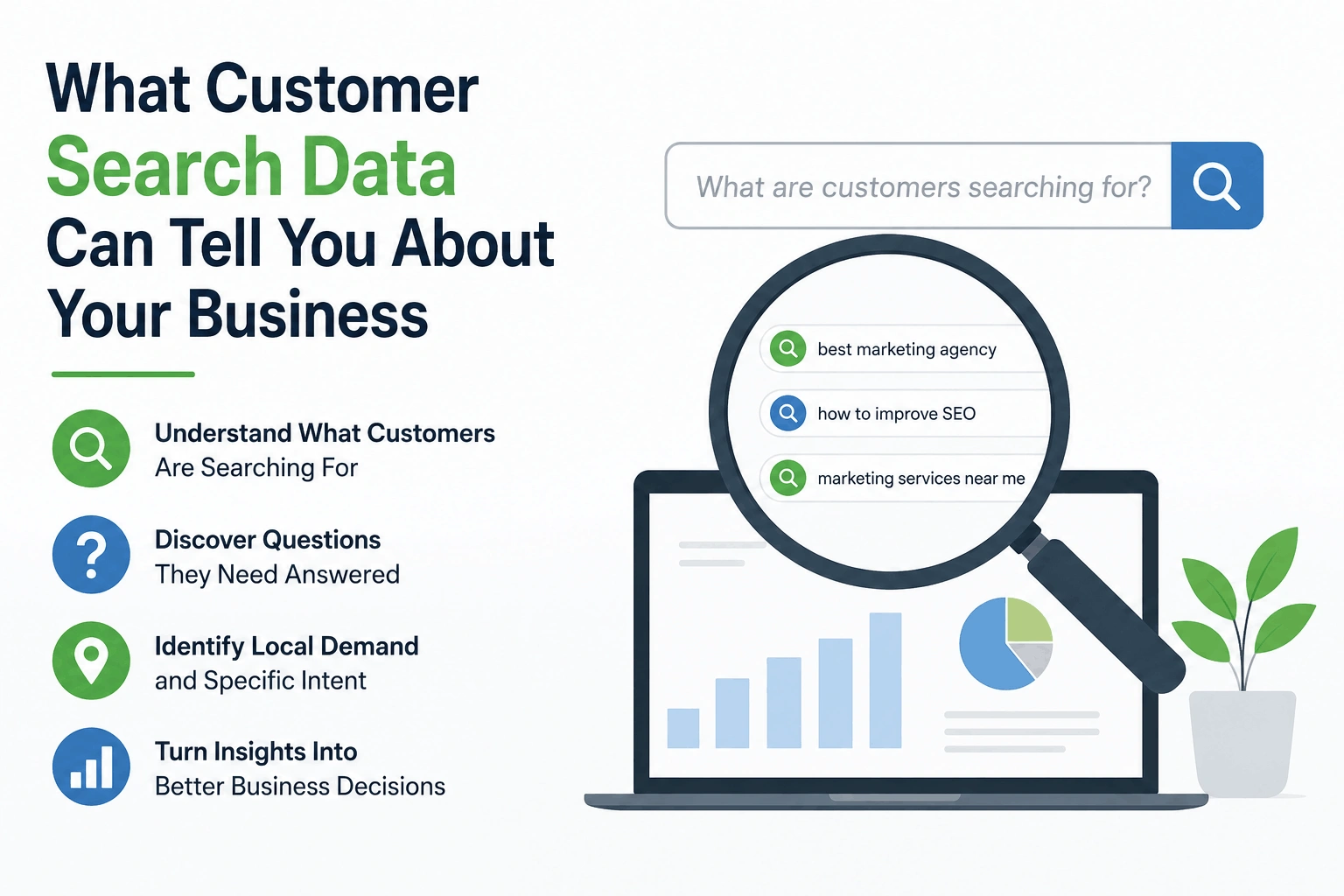
What Customer Search Data Can Tell You About Your Business
Businesses invest significant time and resources trying to understand what customers want. They conduct surveys, analyse reviews, speak with sales teams, and study competitors. Yet another valuable source of customer intelligence is often overlooked: search behaviour. Every search represents a need, question, problem, or intention. When businesses examine these patterns carefully, they can learn how customers describe their needs and what information they require before making a decision.
Search Queries Reveal the Language Customers Actually Use
Companies naturally develop their own terminology for products and services. Employees may use technical phrases or industry-specific language because those terms are familiar internally.
Customers do not always speak the same way.
Someone experiencing a problem may search by describing the symptoms rather than using the professional name for the solution. Others may phrase a service differently from the terminology used on a company’s website.
Understanding these differences can improve communication. Businesses can use search data to identify common questions, descriptions, concerns, and phrases their customers naturally understand.
This does not mean inserting every search term into website copy. The goal is to recognize how customers communicate and ensure important pages explain services in language that makes sense to them.
Questions Can Reveal Where Customers Are Getting Stuck
Question-based searches can provide particularly useful insights into the customer journey.
People frequently search using phrases such as “How do I…?”, “Why does…?”, “When should I…?” or “What is the difference between…?” Each question can reveal uncertainty that exists before a purchase or enquiry.
If potential customers repeatedly ask about the difference between two services, for example, the business may need a clearer comparison. If people continually search for how a particular process works, a step-by-step explanation could address that concern.
These insights can inform FAQs, guides, service descriptions, comparisons, and customer-support resources.
The objective is not to create an article for every question. Businesses should prioritize recurring concerns that are closely related to their services and influence customer decisions.
Search Patterns Can Expose Missing Services and Content
Search data can also reveal gaps between what customers want and what a website currently communicates.
A business may already provide a particular service but mention it only briefly online. Customers might search frequently for that service, yet the website offers no dedicated information explaining it.
Other searches may reveal demand for variations of existing services, comparisons between available options, or information customers need before making a purchase.
These patterns can help companies decide which pages deserve improvement and which customer questions require clearer answers.
Search demand should not automatically determine business strategy, however. A popular query does not necessarily mean a company should introduce a new service. Businesses should compare search insights with operational capabilities, profitability, customer feedback, and broader market research before making larger decisions.
Used carefully, search behaviour becomes another source of evidence rather than a substitute for business judgment.
Local Searches Reveal Where Demand Becomes More Specific
Location can significantly change what a search tells us about customer intent.
A broad query may indicate that someone is researching a topic. Add a city, neighbourhood, or “near me” phrase, and that person may be looking for a provider they can actually contact.
At this stage, customers often want practical information. They may need to know whether the business serves their area, what services are available, how to make contact, and what other customers say about their experience.
Businesses can examine these searches to understand which services generate local interest and which geographic areas show meaningful demand.
This information can also improve location-focused website content. Instead of producing nearly identical pages that simply swap one city name for another, companies can create information that reflects actual customer questions, services, and geographic needs.
Turn Search Insights Into Better Business Decisions
Search information becomes more useful when businesses connect it with decisions rather than treating it purely as keyword data.
Recurring queries might reveal that a service page needs clearer explanations. Location-based searches could identify areas where customers are actively looking for help. Question patterns may suggest new FAQs, while unexpected queries could expose gaps in existing content.
For local businesses trying to turn search behaviour into practical marketing decisions, working with an experienced seo company in lawnside can help identify customer intent, content gaps, local demand, and technical opportunities hidden within organic search data.
The next step is prioritization. Not every query deserves a new page, and not every trend represents a valuable opportunity. Businesses should consider how closely a search relates to their services, whether it reflects genuine customer intent, and what action would provide the greatest value.
This approach turns search analysis from a keyword exercise into a source of customer and market insight.
Search Data Works Better With Real Customer Feedback
Search behaviour can reveal what people ask before reaching a business, but it cannot explain everything.
The strongest insights often emerge when search data is compared with other sources.
Sales conversations can reveal objections that appear repeatedly. Customer-service teams can identify common areas of confusion. Reviews can highlight what customers value after purchasing, while website analytics can show how visitors interact with important information.
When several sources point toward the same issue, the evidence becomes more useful. A question appearing in search data, sales conversations, and customer emails probably deserves greater attention than an isolated keyword with high search volume.
Businesses should therefore treat organic search information as one part of a wider customer-intelligence system.
Search data is not just about rankings. It can reveal how people describe their problems, what information they are missing, and when their interest becomes more specific.
SEO Yodha helps businesses translate these signals into clearer content, stronger local relevance, technical improvements, and organic strategies built around what customers are genuinely trying to find.