Los Angeles Rams vs Tennessee Titans Match Player Stats
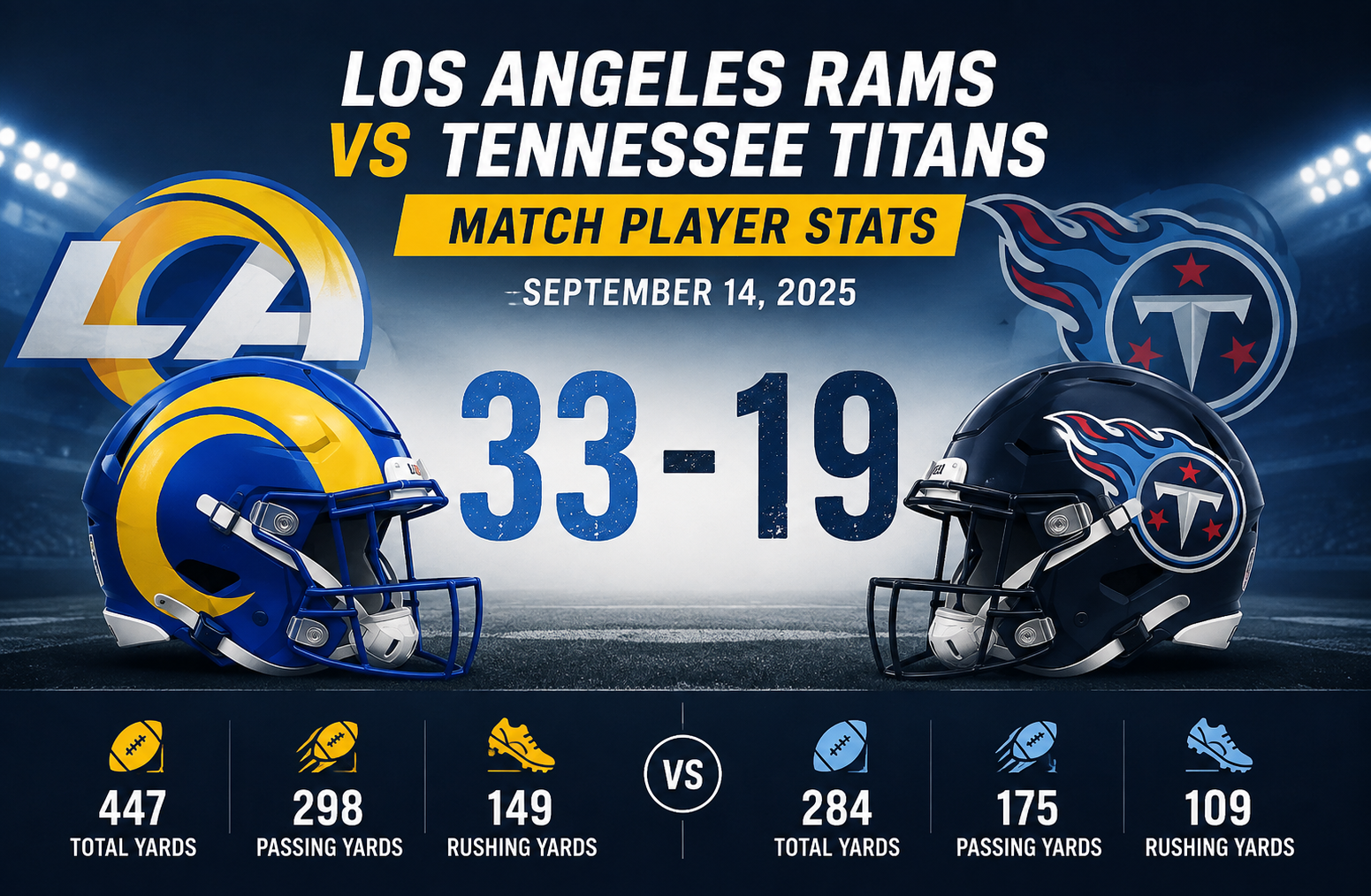
The Los Angeles Rams vs Tennessee Titans match player stats provide a detailed look at how the Rams secured a 33-19 victory over the Titans on September 14, 2025. The game showed a clear contrast between an efficient Rams offense led by Matthew Stafford and a Titans team that struggled to create consistent passing production. While Tennessee found some success on the ground through Tony Pollard and received strong kicking contributions from Joey Slye, Los Angeles controlled the game through explosive plays, balanced rushing, and defensive pressure.
The final score did not tell the entire story. The Titans remained competitive through parts of the game, especially during the second quarter when they scored 13 points. However, the Rams regained control after halftime with improved execution on both sides of the football. The combination of Stafford’s accuracy, Davante Adams’ impact as a receiver, Puka Nacua’s versatility, and a dominant pass rush allowed Los Angeles to move to a 2-0 record.
Analyzing individual performances helps explain why the Rams won and where the Titans faced challenges. Player statistics reveal important details such as offensive efficiency, defensive pressure, turnover impact, and the difference between gaining yards and converting those opportunities into points.
Game Overview: Rams Take Control Against Titans
The September 14, 2025 matchup between the Los Angeles Rams and Tennessee Titans ended with the Rams winning 33-19. Los Angeles improved to a 2-0 record, including a 1-0 away record, while Tennessee dropped to 0-2 with a 0-1 home record.
The Rams built their victory through four quarters of steady improvement:
- First quarter: Rams 7, Titans 0
- Second quarter: Rams 3, Titans 13
- Third quarter: Rams 10, Titans 3
- Fourth quarter: Rams 13, Titans 3
The Titans showed their ability to respond after falling behind early. Their second-quarter performance gave them momentum, but they could not maintain offensive consistency in the second half.
Los Angeles finished the game with stronger overall balance. The Rams produced:
- 298 passing yards
- 149 rushing yards
- 447 total offensive yards
- 2 rushing touchdowns
- 2 passing touchdowns
The Titans recorded:
- 175 passing yards
- 109 rushing yards
- 284 total offensive yards
- 1 passing touchdown
The biggest statistical difference came through the passing game. Stafford generated nearly 300 passing yards, while Cam Ward faced constant pressure and finished with 175 yards through the air.
Los Angeles Rams vs Tennessee Titans Match Player Stats: Quarterback Performance Breakdown
Quarterback play was one of the biggest factors in determining the outcome. The Rams had the advantage because Matthew Stafford consistently moved the football and created scoring opportunities. The Titans struggled because Cam Ward spent much of the game under defensive pressure.
Matthew Stafford Leads Efficient Rams Passing Attack
Matthew Stafford delivered one of the most important performances of the game. He completed 23 of 33 passes for 298 yards, averaging 9.0 yards per attempt. He recorded two touchdowns and one interception.
His complete passing line:
- Completions: 23
- Attempts: 33
- Passing yards: 298
- Average: 9.0 yards per attempt
- Touchdowns: 2
- Interceptions: 1
- Sacks: 1 for 8 yards
- QBR: 63.6
- Passer rating: 105.4
Stafford’s performance showed why experience matters in high-pressure situations. He was able to identify defensive coverage, distribute the ball to multiple targets, and take advantage of Tennessee’s defensive mistakes.
One of the strongest parts of Stafford’s game was his ability to connect on explosive throws. The Rams did not rely on only short passes. They consistently created chunk plays that forced the Titans defense to defend the entire field.
The quarterback also managed the game well after halftime. Instead of forcing risky throws, Stafford helped the Rams maintain control by making efficient decisions and allowing playmakers to create after the catch.
Cam Ward Faces Pressure During Difficult Passing Performance
Titans quarterback Cam Ward completed 19 of 33 passes for 175 yards. He recorded one touchdown and avoided interceptions, but Tennessee’s offense struggled because of limited explosive plays and heavy defensive pressure.
Cam Ward’s passing statistics:
- Completions: 19
- Attempts: 33
- Passing yards: 175
- Average: 5.3 yards per attempt
- Touchdowns: 1
- Interceptions: 0
- Sacks: 5 for 32 yards
- QBR: 27.7
- Passer rating: 82.3
The biggest challenge for Ward was the Rams defensive front. Los Angeles recorded five sacks and eight quarterback hits, making it difficult for Tennessee to establish rhythm.
Although Ward avoided turnovers through the passing game, the sacks created negative plays that limited offensive progress. A quarterback can protect the football, but consistent pressure can still prevent an offense from reaching its potential.
The difference between Stafford and Ward was not only passing numbers. It was also the environment around them. Stafford had better protection and more successful play designs, while Ward often had to make decisions under pressure.
Rams Running Game Creates Balance and Explosive Plays
The Rams rushing attack played an important role in controlling the game. Los Angeles finished with 149 rushing yards on 25 carries, averaging 6.0 yards per attempt.
The rushing statistics showed both consistency and explosiveness. While Kyren Williams handled the majority of traditional rushing attempts, Puka Nacua and Blake Corum created major impact plays.
Kyren Williams Provides Reliable Ground Production
Kyren Williams led the Rams in rushing attempts. He carried the ball 17 times for 66 yards.
His rushing numbers:
- Carries: 17
- Rushing yards: 66
- Average: 3.9 yards
- Touchdowns: 0
- Longest run: 15 yards
Williams did not produce a huge highlight run, but his role was important. He helped maintain offensive balance and forced Tennessee defenders to respect the running game.
A successful rushing performance is not always measured by one long run. Consistent carries can create better passing situations by forcing defenders closer to the line of scrimmage.
Puka Nacua Creates a Game-Changing Rushing Moment
Puka Nacua added an explosive element with one rushing attempt that resulted in a 45-yard touchdown.
His rushing statistics:
- Carries: 1
- Yards: 45
- Average: 45.0
- Touchdowns: 1
- Long run: 45 yards
This play highlighted the Rams’ ability to create unexpected opportunities. Nacua’s versatility made him difficult for the Titans defense to predict.
A receiver who can contribute as both a pass catcher and runner gives an offense additional ways to attack defensive weaknesses.
Blake Corum Adds Valuable Support
Blake Corum provided another strong contribution on the ground. He recorded:
- Carries: 5
- Rushing yards: 44
- Average: 8.8
- Touchdowns: 1
- Long run: 15 yards
Corum’s efficiency stood out. Even with fewer opportunities, he averaged more than eight yards per carry and added a rushing touchdown.
The combination of Williams’ workload, Corum’s efficiency, and Nacua’s explosive play gave the Rams a balanced rushing attack that helped protect their lead.
Tony Pollard Leads Titans Rushing Effort
For Tennessee, Tony Pollard was the most productive runner. He carried the ball 20 times for 92 yards.
Pollard’s rushing line:
- Carries: 20
- Rushing yards: 92
- Average: 4.6
- Touchdowns: 0
- Long run: 10 yards
Pollard consistently gained positive yardage and was one of the few Titans players who created reliable offensive production.
However, Tennessee could not turn his rushing success into enough points. The Rams defense was able to limit explosive plays and force the Titans into longer drives.
A strong individual rushing performance can help an offense, but it becomes less valuable when passing struggles and penalties or negative plays prevent scoring opportunities.
Offensive Comparison: Rams Create More Big Plays
Looking deeper into the Los Angeles Rams vs Tennessee Titans match player stats, the offensive difference came from efficiency and explosive plays.
The Rams produced:
- 447 total yards
- 298 passing yards
- 149 rushing yards
- 4 total touchdowns
The Titans produced:
- 284 total yards
- 175 passing yards
- 109 rushing yards
- 1 total touchdown
The Rams averaged more yards through the air and on the ground. Their ability to combine passing success with rushing efficiency prevented Tennessee from focusing on one area.
The Titans had moments of success, especially with Pollard’s rushing production and Joey Slye’s field goal accuracy, but they struggled to consistently finish drives.
Los Angeles Rams Receiving Performance: Playmakers Change the Game
The receiving statistics from the Los Angeles Rams vs Tennessee Titans match player stats show how Los Angeles created separation through multiple offensive weapons. Instead of relying on one receiver, the Rams spread opportunities across their passing group.
Matthew Stafford completed 23 passes, and those completions produced 298 receiving yards with two passing touchdowns. The Rams receiving unit averaged 13.0 yards per reception, showing their ability to create meaningful gains rather than only short completions.
The Titans defense struggled to contain the Rams’ top targets, especially Davante Adams and Puka Nacua. Both players played different roles, with Adams providing a reliable deep and intermediate threat while Nacua contributed through both receiving and rushing plays.
Davante Adams Dominates as Rams Receiving Leader
Davante Adams delivered the most productive receiving performance of the game. He finished with six receptions for 106 yards and one touchdown.
His receiving statistics:
- Receptions: 6
- Targets: 13
- Receiving yards: 106
- Average: 17.7 yards per reception
- Touchdowns: 1
- Long reception: 33 yards
Adams was the primary explosive target for Stafford. His 17.7 yards per reception average showed that he was not only used for short possession catches. The Rams consistently trusted him in situations where they needed significant yardage.
His 13 targets also showed his importance in the offensive game plan. Stafford repeatedly looked toward Adams when the Rams needed to create momentum.
A receiver with Adams’ experience provides value beyond statistics. His route running, timing, and ability to win individual matchups help create opportunities for other players as well.
Puka Nacua Provides Versatility and Big-Play Ability
Puka Nacua continued to show why versatile offensive players are valuable in modern NFL offenses.
His receiving statistics:
- Receptions: 8
- Targets: 9
- Receiving yards: 91
- Average: 11.4 yards per reception
- Touchdowns: 0
- Long reception: 24 yards
Nacua led the Rams in receptions and was one of Stafford’s most reliable options. His ability to gain yards after the catch helped the Rams maintain offensive pressure.
His impact was not limited to receiving. The 45-yard rushing touchdown demonstrated how the Rams used creative ways to involve him in the offense.
When a defense must prepare for a player who can contribute in multiple areas, it becomes harder to predict formations and coverage assignments.
Other Rams Receivers Add Important Contributions
Several other Rams players contributed valuable plays.
Jordan Whittington
Jordan Whittington recorded:
- Receptions: 2
- Targets: 2
- Receiving yards: 42
- Average: 21.0 yards
- Long reception: 40 yards
His two catches were limited in number but highly efficient. The 40-yard reception helped create additional pressure on the Titans secondary.
Tyler Higbee
Tyler Higbee contributed:
- Receptions: 4
- Targets: 4
- Receiving yards: 37
- Average: 9.3 yards
- Long reception: 20 yards
Higbee provided Stafford with a dependable middle-field option and helped maintain balance in the passing attack.
Davis Allen
Davis Allen recorded:
- Receptions: 1
- Targets: 1
- Receiving yards: 8
- Touchdowns: 1
His touchdown showed that the Rams were able to use different players in scoring situations.
Titans Receiving Unit Searches for Consistency
The Titans receiving group produced fewer explosive plays compared with the Rams. Tennessee finished with:
- 19 receptions
- 175 receiving yards
- 1 touchdown
- 9.2 yards per reception
The team had some positive individual performances, but the overall passing attack lacked the consistency needed to match Los Angeles.
Calvin Ridley Leads Titans Receivers
Calvin Ridley was the top receiving option for Tennessee.
His receiving statistics:
- Receptions: 3
- Targets: 6
- Receiving yards: 57
- Average: 19.0 yards
- Touchdowns: 0
- Long reception: 26 yards
Ridley showed his ability to create separation and produce efficient plays when targeted. His 19.0 yards per reception average was the highest among Titans receivers with multiple catches.
However, Tennessee needed more volume and more consistent production from the passing game to keep pace with the Rams.
Elic Ayomanor Provides Touchdown Contribution
Elic Ayomanor recorded:
- Receptions: 4
- Targets: 6
- Receiving yards: 56
- Average: 14.0 yards
- Touchdowns: 1
- Long reception: 23 yards
Ayomanor was one of the most productive Titans offensive players. His touchdown helped Tennessee stay competitive, but the team struggled to generate enough scoring drives.
Chig Okonkwo Helps Move the Chains
Chig Okonkwo finished with:
- Receptions: 4
- Targets: 6
- Receiving yards: 35
- Average: 8.8 yards
- Long reception: 14 yards
His role was mainly focused on shorter completions that helped maintain drives.
The Titans needed more explosive plays from the passing attack because the Rams defense consistently created pressure.
Defensive Breakdown: Rams Pressure Changes the Outcome
Defense played a major role in the final result. The Rams defensive performance was one of the biggest reasons Tennessee could not complete its comeback attempt.
Los Angeles finished with:
- 69 total tackles
- 46 solo tackles
- 5 sacks
- 6 tackles for loss
- 4 pass deflections
- 8 quarterback hits
The pressure numbers tell an important story. The Rams repeatedly disrupted Cam Ward’s timing and prevented the Titans offense from developing a consistent rhythm.
Kamren Kinchens Leads Rams Defense
Kamren Kinchens was the leading tackler for Los Angeles.
His defensive statistics:
- Total tackles: 10
- Solo tackles: 7
Kinchens played an important role in limiting Tennessee’s offensive progress. His tackling production showed strong involvement in stopping plays and finishing defensive assignments.
Rams Pass Rush Creates Problems for Cam Ward
The Rams recorded five sacks against the Titans offensive line.
Sack leaders:
Byron Young
- Sacks: 2
Young was the most disruptive pass rusher for Los Angeles. His ability to pressure the quarterback affected Tennessee’s ability to develop deeper passing plays.
Kam Curl
- Sacks: 1
Curl contributed important pressure and helped the Rams maintain defensive control.
Kobie Turner
- Sacks: 1
Turner added interior pressure and made the pocket uncomfortable for Cam Ward.
Josaiah Stewart
- Sacks: 1
Stewart completed the Rams’ five-sack performance.
A strong pass rush often changes games because it affects every passing decision. Even when a quarterback avoids interceptions, constant pressure can reduce offensive efficiency.
Titans Defense Shows Individual Effort
The Titans defense finished with:
- 62 total tackles
- 36 solo tackles
- 1 sack
- 2 tackles for loss
- 4 pass deflections
- 6 quarterback hits
Although Tennessee allowed 33 points, individual defenders made important contributions.
Amani Hooker Leads Titans Defense
Amani Hooker was the defensive leader for Tennessee.
His statistics:
- Total tackles: 8
- Solo tackles: 5
- Sacks: 1
Hooker was active throughout the game and contributed against both the run and pass.
Cody Barton Records Titans Interception
Cody Barton recorded the only Titans interception:
- Interceptions: 1
- Return yards: 0
- Defensive touchdowns: 0
The interception was a positive moment for Tennessee’s defense, but the Titans could not generate enough stops afterward to change the final outcome.
Turnovers and Mistakes Influence Momentum
Turnovers often decide close NFL games, and this matchup included mistakes from both sides.
The Rams recorded:
- Total fumbles: 2
- Fumbles lost: 0
Matthew Stafford had one fumble, but the Rams recovered it. Nate Landman also recorded a recovered fumble.
The Titans recorded:
- Total fumbles: 1
- Fumbles lost: 1
Cam Ward lost his fumble, giving the Rams an additional opportunity.
The difference was not only the number of turnovers. It was the timing and impact. The Rams avoided losing possessions, while Tennessee gave Los Angeles an extra chance.
Special Teams Performance: Kickers Provide Valuable Points
Special teams also played an important role in the final score.
Joshua Karty Helps Rams Score
Rams kicker Joshua Karty finished:
- Field goals: 2/2
- Field goal percentage: 100%
- Long field goal: 21 yards
- Extra points: 3/4
- Total points: 9
Karty contributed important points and supported the Rams’ offensive production.
Joey Slye Keeps Titans Competitive
Titans kicker Joey Slye produced a strong individual performance:
- Field goals: 4/4
- Field goal percentage: 100%
- Long field goal: 57 yards
- Extra points: 1/1
- Total points: 13
Slye’s kicking accuracy kept Tennessee within reach. His 57-yard field goal showed impressive range.
However, field goals alone were not enough because the Titans struggled to produce touchdowns consistently.
Los Angeles Rams vs Tennessee Titans Match Player Stats: Key Factors Behind the Result
The Los Angeles Rams vs Tennessee Titans match player stats show that the final score was decided by several important areas rather than one single performance. The Rams won because they combined efficient quarterback play, explosive offensive moments, and a defensive front that consistently pressured the Titans.
The Titans had some strong individual performances, especially from Tony Pollard, Calvin Ridley, and Joey Slye. However, football games are usually decided by overall execution, and Los Angeles performed better in the areas that directly affected scoring opportunities.
Here are the biggest factors that shaped the game.
1. Rams Passing Efficiency Created Offensive Separation
The biggest statistical advantage came through the passing game.
Matthew Stafford finished with 298 passing yards compared with Cam Ward’s 175 yards. The difference of 123 passing yards allowed the Rams to create more scoring opportunities.
Stafford also averaged 9.0 yards per attempt, while Ward averaged 5.3 yards per attempt. This showed that Los Angeles was more successful at creating meaningful gains through the air.
The Rams passing attack benefited from:
- Better protection
- Multiple reliable receiving options
- More explosive plays
- Strong quarterback decision-making
Davante Adams and Puka Nacua were the biggest contributors, combining for 197 receiving yards. Their ability to consistently win matchups gave Stafford dependable options throughout the game.
2. Defensive Pressure Limited Tennessee’s Offensive Growth
The Rams defense changed the game with pressure.
Five sacks against Cam Ward made it difficult for the Titans to maintain offensive rhythm. Tennessee’s quarterback had limited time to develop plays, which reduced the effectiveness of deeper passing attempts.
The difference between the two defenses was clear:
Rams defense:
- 5 sacks
- 8 quarterback hits
- 6 tackles for loss
Titans defense:
- 1 sack
- 6 quarterback hits
- 2 tackles for loss
Pressure does not always appear in the box score through interceptions or forced fumbles. Sometimes its biggest impact is forcing incomplete passes, shortening drives, and creating difficult situations.
The Rams consistently created those situations.
3. Explosive Plays Changed Field Position
The Rams created several important explosive plays that helped separate the teams.
The biggest examples included:
- Puka Nacua’s 45-yard rushing touchdown
- Jordan Whittington’s 40-yard reception
- Davante Adams’ 33-yard reception
These plays changed the momentum because they allowed Los Angeles to move quickly down the field.
The Titans had some explosive moments, including Calvin Ridley’s 26-yard reception and Joey Slye’s 57-yard field goal, but they did not create enough offensive plays that directly resulted in touchdowns.
4. Titans Rushing Success Was Not Enough
Tony Pollard had an impressive individual performance. His 92 rushing yards on 20 carries gave Tennessee a reliable offensive option.
The Titans rushing attack finished with:
- 26 carries
- 109 yards
- 4.2 yards per carry
However, the Rams were more efficient overall. Los Angeles averaged 6.0 yards per carry and scored two rushing touchdowns.
The difference was not simply total rushing yards. It was how effectively each team converted rushing production into points.
5. Red Zone and Scoring Efficiency Favored Los Angeles
The Rams finished with four total touchdowns:
- Two passing touchdowns
- Two rushing touchdowns
The Titans scored only one touchdown through the offense.
Although Tennessee’s kicker Joey Slye produced 13 points, field goals could not match the scoring ability of the Rams offense.
This created a situation where the Titans needed more successful drives but struggled against a strong Rams defensive front.
Lessons From the Matchup for Future Performances
This game provided several important lessons for both teams.
What the Rams Can Build On
The Rams showed several positive signs:
Balanced Offensive Identity
Los Angeles did not depend on only one player. Stafford distributed opportunities among Adams, Nacua, Higbee, Whittington, and others.
A balanced offense becomes harder to defend because opponents cannot focus on eliminating one threat.
Strong Defensive Front
The five-sack performance showed that the Rams defensive line can impact games without depending entirely on turnovers.
Creating pressure consistently can help the defense remain effective against different offensive styles.
Versatile Playmakers
Players like Puka Nacua provide additional value because they can contribute in different ways. His rushing touchdown showed how creative offensive schemes can create matchup problems.
Areas the Titans Need to Improve
Despite individual successes, Tennessee had several challenges.
Improve Pass Protection
Allowing five sacks created too many negative plays. Better protection would give Cam Ward more time to make decisions.
Create More Explosive Offensive Plays
The Titans averaged 9.2 yards per reception as a team compared with the Rams’ 13.0 yards per reception.
More explosive passing plays would help reduce pressure on the running game.
Convert Drives Into Touchdowns
The Titans moved the ball at times but struggled to finish drives. Turning field goal opportunities into touchdowns will be important in future games.
How to Read Player Statistics From NFL Games
Many fans look only at final scores, but player statistics provide deeper understanding.
When analyzing a game, important areas include:
Quarterback Statistics
Look beyond passing yards.
Important measurements include:
- Completion percentage
- Yards per attempt
- Touchdowns and interceptions
- Sacks taken
- Passer rating
A quarterback who throws for fewer yards may still perform well if they make efficient decisions.
Running Back Statistics
Rushing yards alone do not show the full picture.
Important factors include:
- Carries
- Average yards per carry
- Explosive runs
- Touchdowns
- Receiving contribution
Kyren Williams and Tony Pollard showed different types of value in this matchup.
Receiver Statistics
Receiving numbers should be viewed through:
- Targets
- Catch percentage
- Average yards per reception
- Big plays
- Touchdowns
Davante Adams had fewer receptions than Puka Nacua but created major impact through efficiency and explosive gains.
Defensive Statistics
Defense requires more than counting tackles.
Important measurements include:
- Sacks
- Quarterback hits
- Tackles for loss
- Forced turnovers
- Pass deflections
The Rams defensive pressure numbers explain why Tennessee struggled offensively.
Frequently Asked Questions About Los Angeles Rams vs Tennessee Titans Match Player Stats
Who won the Los Angeles Rams vs Tennessee Titans game in 2025?
The Los Angeles Rams defeated the Tennessee Titans 33-19 on September 14, 2025.
Who was the Rams leading passer against the Titans?
Matthew Stafford was the Rams leading passer. He completed 23 of 33 passes for 298 yards, two touchdowns, and one interception.
Who led the Titans in rushing against the Rams?
Tony Pollard led Tennessee’s rushing attack with 20 carries for 92 yards.
Which Rams player had the most receiving yards?
Davante Adams led the Rams in receiving yards with 106 yards on six receptions and scored one touchdown.
How many sacks did the Rams record against Cam Ward?
The Rams recorded five sacks against Cam Ward during the game.
What was the biggest difference between the Rams and Titans?
The biggest difference was offensive efficiency. The Rams produced 447 total yards compared with the Titans’ 284 yards and scored four touchdowns compared with Tennessee’s one touchdown.
Conclusion
The Los Angeles Rams vs Tennessee Titans matchup highlighted the importance of complete team performance. The Rams controlled the game through strong quarterback play, explosive offensive contributions, and a defense that consistently pressured the quarterback.
Matthew Stafford’s efficient passing, Davante Adams’ receiving impact, Puka Nacua’s versatility, and the Rams pass rush created the foundation for a convincing victory.
The Titans showed positive individual performances from Tony Pollard, Calvin Ridley, and Joey Slye, but they struggled to maintain offensive consistency against a disciplined Rams defense.
The detailed player statistics reveal that Los Angeles earned the victory by performing better in the areas that create winning football: explosive plays, defensive pressure, and efficient scoring.