Celtics vs LA Clippers Match Player Stats
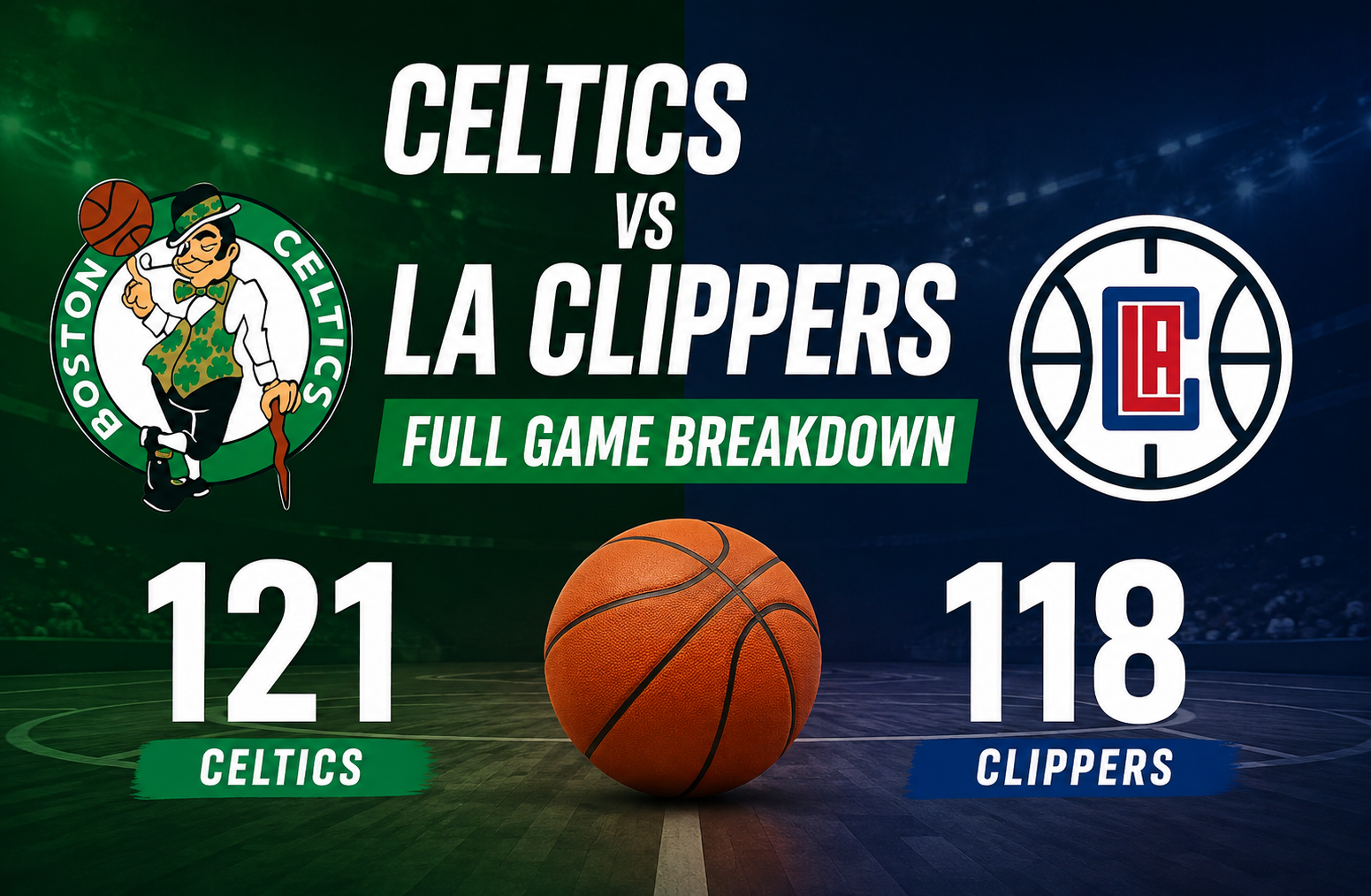
The celtics vs la clippers match player stats from the November 17, 2025 meeting tell the story of a tightly contested game that Boston ultimately won 121-118 at TD Garden. The Celtics overcame a strong second-half push from the Clippers, led by a huge scoring night from James Harden, while Jaylen Brown and Payton Pritchard provided the offensive production Boston needed to survive the final minutes.
The three-point line played an important role throughout the game. Boston made 16 of 39 attempts from beyond the arc, while Los Angeles converted 14 of 35. The Celtics also gained a major advantage on the glass and protected the ball exceptionally well, finishing with only six turnovers compared with 13 for the Clippers.
This was not a game decided by one simple statistic. Boston shot 45% from the field compared with 47% for Los Angeles, and the Clippers actually had the better free-throw percentage at 93%. Instead, the Celtics created enough extra possessions through rebounding and turnover control to offset Los Angeles’ efficient shooting.
Celtics vs LA Clippers Match Player Stats
Boston finished the game with 121 points, 49 rebounds, 26 assists, six steals, six blocks, and only six turnovers. Los Angeles recorded 118 points, 44 rebounds, 23 assists, four steals, seven blocks, and 13 turnovers.
The final three-point margin made every possession important, but the underlying numbers show why Boston was able to stay ahead.
| Team | Points | FG | 3PT | FT | REB | AST | TO |
| Boston Celtics | 121 | 46-103 | 16-39 | 13-17 | 49 | 26 | 6 |
| LA Clippers | 118 | 38-81 | 14-35 | 28-30 | 44 | 23 | 13 |
Boston attempted 22 more field goals than Los Angeles. That difference is extremely important.
The Clippers were more efficient from the field, but Boston generated many more shooting opportunities. The Celtics also collected 20 offensive rebounds, compared with 10 for the Clippers. That gave Boston repeated chances to score after missed shots.
Final Score by Quarter
The game changed rhythm several times.
| Quarter | Clippers | Celtics |
| 1st | 30 | 37 |
| 2nd | 19 | 26 |
| 3rd | 36 | 27 |
| 4th | 33 | 31 |
| Final | 118 | 121 |
Boston started strongly, taking a 37-30 lead after the opening quarter. The Celtics extended that advantage in the second period and entered halftime with a 14-point lead.
Los Angeles responded aggressively after halftime.
The Clippers scored 36 points in the third quarter while Boston managed 27. That reduced the deficit significantly and set up a competitive fourth quarter.
Los Angeles then scored 33 points in the final period, but Boston answered with 31 and held on for the three-point victory.
James Harden Leads the Clippers With 37 Points
James Harden was the clear offensive leader for Los Angeles.
He finished with:
- 37 points
- 9-of-22 field goals
- 5-of-11 three-pointers
- 14-of-15 free throws
- 7 rebounds
- 8 assists
- 3 turnovers
- 1 steal
Harden’s 37 points represented more than 31% of the Clippers’ total scoring.
His efficiency from the free-throw line was particularly important. Harden made 14 of 15 attempts, allowing him to produce a high-scoring performance even though he shot 9 of 22 from the field.
He also contributed seven rebounds and eight assists, meaning his impact was not limited to scoring.
However, his plus/minus was -8. That number does not mean Harden played poorly. In fact, his scoring and playmaking were central to Los Angeles staying within striking distance.
It shows something more subtle about the game. Harden produced at a very high individual level, but Boston’s overall possession advantage was enough to keep the Clippers behind.
Ivica Zubac Controls the Interior
Ivica Zubac recorded 16 points and 12 rebounds.
His full line included:
- 16 points
- 6-of-10 shooting
- 4-of-4 free throws
- 12 rebounds
- 2 assists
- 1 turnover
- 1 steal
- 1 block
Zubac was the Clippers’ leading rebounder.
His 12 boards helped Los Angeles compete against Boston’s frontcourt, but the Clippers still lost the overall rebounding battle 49-44.
That five-rebound difference does not look enormous at first glance. The more important number is offensive rebounding. Boston collected twice as many offensive rebounds as Los Angeles.
John Collins Provides Efficient Scoring
John Collins scored 17 points on 8-of-13 shooting.
He also recorded:
- 2 rebounds
- 1 three-pointer
- 0 turnovers
- 0 assists
His 61.5% field-goal shooting was one of the more efficient individual performances on the Clippers’ side.
Collins did not need a large number of attempts to produce his points. His scoring helped Los Angeles maintain offensive efficiency despite Boston’s pressure.
Supporting Production From the Clippers
The Clippers received useful contributions from several players.
Kobe Sanders scored 11 points while shooting 4 of 7 from the field and 2 of 3 from three-point range. He also added six rebounds, two assists, one steal, and finished with a +16 plus/minus.
Bogdan Bogdanovic contributed 11 points, four rebounds, and three assists. His +18 plus/minus was the best among Clippers players listed in the supplied box score.
Brook Lopez added five points, two rebounds, three assists, one steal, and one block. Despite the modest scoring total, he finished at +11.
Nicolas Batum scored six points and made two of his four three-point attempts. He also recorded four rebounds and two blocks.
Jordan Miller scored four points, while the Clippers also received six points from Kris Dunn.
Jaylen Brown Delivers an All-Around Performance
Jaylen Brown was Boston’s leading scorer and leading rebounder.
He finished with:
- 33 points
- 14-of-33 field goals
- 1-of-7 three-pointers
- 4-of-7 free throws
- 13 rebounds
- 3 assists
- 1 turnover
- 2 steals
- 1 block
- +22 plus/minus
Brown’s performance stands out because he influenced the game in several areas.
His 13 rebounds were especially valuable. Boston needed those possessions because the Celtics were not as efficient from the field as Los Angeles.
Brown shot only 1 of 7 from three-point range, yet he still scored 33 points. That indicates his production came primarily through two-point scoring and pressure around the basket rather than long-range shooting.
His +22 was also the strongest plus/minus among the Boston players listed in the supplied data.
That combination of scoring, rebounding, defense, and ball security made Brown one of the most complete performers in the game.
Payton Pritchard’s Eight Three-Pointers Change the Game
Payton Pritchard scored 30 points and was arguably the most explosive shooter in the game.
His line was:
- 30 points
- 10-of-16 field goals
- 8-of-13 three-pointers
- 2-of-2 free throws
- 3 rebounds
- 2 assists
- 0 turnovers
Pritchard’s eight made three-pointers were a major reason Boston could score 121 points.
He shot 61.5% from the field and 61.5% from three-point range based on the supplied attempts and makes. His 13 three-point attempts were the highest volume of any Boston player in the game.
There is also an interesting contrast in his plus/minus.
Despite scoring 30 points, Pritchard finished at -15.
That illustrates why plus/minus should never be used alone to evaluate a player’s performance. A player can score efficiently while sharing minutes with lineups that struggle defensively or give up runs.
Pritchard’s scoring clearly mattered. The Celtics needed that perimeter production to overcome the Clippers’ efficient shooting.
Derrick White Controls the Game as a Playmaker
Derrick White produced one of Boston’s most balanced performances.
He recorded:
- 22 points
- 7-of-17 field goals
- 4-of-8 three-pointers
- 4-of-4 free throws
- 7 rebounds
- 9 assists
- 1 turnover
- 2 blocks
- +20 plus/minus
His nine assists were the most on Boston.
White’s combination of scoring and playmaking gave the Celtics another offensive creator alongside Brown and Pritchard.
His one turnover is particularly notable considering his nine assists. That is a strong possession-management performance in a game where turnover differential mattered significantly.
White also contributed two blocks, showing that his influence extended beyond offense.
Neemias Queta Makes an Impact Inside
Neemias Queta finished with 14 points and nine rebounds.
His statistical line included:
- 14 points
- 7-of-16 field goals
- 9 rebounds
- 3 assists
- 1 steal
- 1 block
- 0 turnovers
- +16 plus/minus
Queta’s zero turnovers were valuable, especially for a frontcourt player handling offensive possessions.
His nine rebounds also helped Boston maintain its advantage on the glass.
The combination of Queta’s interior work and Brown’s 13 rebounds contributed to Boston’s 49-rebound total.
Jordan Walsh Adds Defensive Energy
Jordan Walsh scored only six points, but his overall contribution was more substantial than his scoring total suggests.
He finished with:
- 6 points
- 8 rebounds
- 3 assists
- 3 steals
- 1 block
- +4 plus/minus
The three steals were especially notable.
Walsh provided defensive activity while also contributing eight rebounds and three assists. His numbers demonstrate why a player does not need to score heavily to influence a close game.
Boston’s Bench Has Mixed Results
The Celtics received 13 points from Luka Garza, who shot 5 of 6 from the field and made both of his three-point attempts.
Garza’s efficiency was excellent, but his plus/minus was -14.
Baylor Scheierman added three points, two rebounds, two assists, one steal, and one block.
Sam Hauser did not score, finishing 0 of 3 from the field and 0 of 3 from three-point range.
Josh Minott also went scoreless, while Anfernee Simons finished without points and recorded two assists against two turnovers.
These numbers show that Boston’s main production came from its primary contributors rather than consistent scoring throughout the bench.
Shooting Efficiency vs. Shot Volume
One of the most interesting elements of the game is the difference between efficiency and volume.
The Clippers shot 47% from the field.
Boston shot 45%.
At first glance, that appears to favor Los Angeles.
The Clippers also shot 93% from the free-throw line compared with Boston’s 76%.
Yet Boston won.
Why?
The Celtics attempted 103 field goals compared with only 81 for the Clippers.
That is a 22-attempt difference.
Boston also made 16 three-pointers and collected 20 offensive rebounds. Those extra possessions allowed the Celtics to compensate for their slightly lower shooting percentage.
This is an important lesson when analyzing basketball box scores. Field-goal percentage alone does not explain who controlled the game.
Turnovers Give Boston an Important Advantage
The turnover numbers were even more revealing.
Boston committed six turnovers.
Los Angeles committed 13.
That gave the Celtics a seven-turnover advantage.
In a game decided by three points, seven additional possessions can be enormous.
Boston also recorded 26 assists against those six turnovers. The Celtics moved the ball effectively without giving away many possessions.
The Clippers had 23 assists, which was only three fewer than Boston. Their problem was not a complete lack of ball movement.
Instead, the difference came from possession security.
Boston created more opportunities and gave fewer opportunities away.
Offensive Rebounding Was a Major Factor
Boston collected 20 offensive rebounds.
Los Angeles collected 10.
That is a 10-rebound advantage on the offensive glass.
This is arguably one of the clearest explanations for Boston’s victory.
The Celtics shot 45% from the field, meaning they missed more than half of their attempts. However, many of those misses did not immediately end the possession.
Twenty offensive rebounds created additional scoring opportunities.
The Clippers shot more efficiently, but Boston repeatedly gave itself another chance to score.
In a three-point game, those extra possessions can be the difference between winning and losing.
Three-Point Shooting Kept Boston Ahead
Both teams were dangerous from three-point range.
Boston made 16 of 39 attempts for approximately 41%.
Los Angeles made 14 of 35 attempts for 40%.
The difference was only two made three-pointers.
Pritchard accounted for eight of Boston’s 16 makes by himself.
White added four.
The remaining Celtics made four combined.
For Los Angeles, Harden made five three-pointers.
That means Harden and Pritchard were responsible for a large portion of the game’s perimeter scoring.
Their performances helped create the high-scoring environment despite the relatively modest overall field-goal percentages.
Free Throws Tell Another Part of the Story
Los Angeles had a significant advantage at the free-throw line.
The Clippers made 28 of 30 attempts.
Boston made 13 of 17.
That represents a 15-point difference in made free throws.
Harden alone made 14 free throws.
Despite that major advantage, Los Angeles still lost by three points.
This is important because it highlights how strongly Boston performed in other areas.
The Celtics gave up substantial free-throw production but compensated with:
- More field-goal attempts
- More offensive rebounds
- Fewer turnovers
- Two additional made three-pointers
- Five more total rebounds
- Three more assists
The final result was therefore a balance of several statistical advantages rather than dominance in one category.
Plus/Minus Provides Some Surprising Results
Plus/minus can help explain lineup impact, but this game shows why it needs context.
Jaylen Brown finished at +22.
Derrick White finished at +20.
Neemias Queta finished at +16.
Baylor Scheierman finished at +12.
Jordan Walsh finished at +4.
Meanwhile, Payton Pritchard finished at -15 despite scoring 30 points.
On the Clippers, Bogdan Bogdanovic finished at +18, Kobe Sanders at +16, and Brook Lopez at +11.
James Harden finished at -8 despite scoring 37 points.
These numbers should not be interpreted as a simple ranking of who played well.
Plus/minus measures what happened while a player was on the court. It does not isolate individual scoring efficiency, defensive quality, opponent strength, or teammate combinations.
The best analysis combines plus/minus with the player’s complete box score.
What the Box Score Says About Boston’s Win
The Celtics’ victory can be explained through four major factors.
1. Boston Won the Possession Battle
The Celtics attempted 103 field goals compared with 81 for Los Angeles.
That is a huge difference.
2. Boston Dominated Offensive Rebounding
The Celtics grabbed 20 offensive rebounds.
The Clippers grabbed 10.
Those extra possessions helped Boston generate more attempts.
3. Boston Protected the Ball
Six turnovers compared with 13 was a major advantage.
The Celtics did not waste many possessions.
4. Boston Got Elite Perimeter Scoring
Pritchard scored 30 points and made eight three-pointers.
White added 22 points and four three-pointers.
Together, they gave Boston 52 points from two of its backcourt contributors.
What the Clippers Could Take From the Game
Los Angeles did several things well.
The Clippers shot 47% from the field.
They made 93% of their free throws.
Harden scored 37 points and delivered eight assists.
Zubac grabbed 12 rebounds.
The Clippers also produced seven blocks, one more than Boston.
Their biggest problem was possession volume.
The team committed 13 turnovers while collecting only 10 offensive rebounds. That made it difficult to match Boston’s number of offensive opportunities.
Even with efficient shooting, the Clippers needed to limit wasted possessions against a team that was generating extra attempts.
The Importance of the Fourth Quarter
The fourth quarter was essentially a one-possession battle.
Los Angeles scored 33 points.
Boston scored 31.
The Clippers made a strong push, but the deficit created during the first half proved too large to completely erase.
The Celtics’ 63-49 halftime advantage gave them enough room to absorb Los Angeles’ second-half comeback.
That is an important part of reading the game.
Looking only at the third and fourth quarters could make it seem like Los Angeles controlled the contest. Looking at the complete game shows that Boston’s early advantage created the foundation for the win.
A Closer Look at the Game’s Leading Scorers
The four biggest scoring performances were:
| Player | Team | Points | FG | 3PT | REB | AST |
| James Harden | Clippers | 37 | 9-22 | 5-11 | 7 | 8 |
| Jaylen Brown | Celtics | 33 | 14-33 | 1-7 | 13 | 3 |
| Payton Pritchard | Celtics | 30 | 10-16 | 8-13 | 3 | 2 |
| Derrick White | Celtics | 22 | 7-17 | 4-8 | 7 | 9 |
Harden had the highest scoring total.
Brown delivered the strongest all-around scoring and rebounding combination.
Pritchard provided the most explosive three-point shooting.
White offered the most balanced playmaking performance.
Together, these individual performances explain why the game remained competitive until the final possessions.
Celtics vs LA Clippers Match Player Stats: Key Takeaways
The most useful way to interpret the celtics vs la clippers match player stats is to look beyond the final score.
Boston did not win because it shot better overall. It did not win because it dominated free throws. It did not even win because it had one overwhelming scorer.
Instead, the Celtics combined several smaller advantages.
They created 22 more field-goal attempts, grabbed twice as many offensive rebounds, committed seven fewer turnovers, and made two more three-pointers.
At the individual level, Brown provided 33 points and 13 rebounds. Pritchard made eight three-pointers. White delivered nine assists with only one turnover. Queta added nine rebounds and 14 points.
Los Angeles had its own outstanding performances.
Harden scored 37 points with eight assists.
Zubac produced a double-double with 16 points and 12 rebounds.
Collins shot 8 of 13.
Sanders and Bogdanovic both finished with 11 points and positive plus/minus figures.
The result was a game where the Clippers were highly efficient but Boston was better at creating and protecting possessions.
Frequently Asked Questions
Who led the Clippers in scoring against the Celtics?
James Harden led the Clippers with 37 points. He also recorded seven rebounds and eight assists.
Who led Boston in scoring?
Jaylen Brown led the Celtics with 33 points. He also collected 13 rebounds, three assists, two steals, and one block.
How many three-pointers did Payton Pritchard make?
Payton Pritchard made eight three-pointers on 13 attempts and finished with 30 points.
Who had the most rebounds in the game?
Jaylen Brown led all players with 13 rebounds. Ivica Zubac was the Clippers’ leading rebounder with 12.
Which team had fewer turnovers?
Boston committed six turnovers, while Los Angeles committed 13.
What was the final score between Boston and the Clippers?
The Boston Celtics defeated the LA Clippers 121-118 on November 17, 2025, at TD Garden.
Conclusion
The celtics vs la clippers match player stats from November 17, 2025 show how a close NBA game can be decided by possession control rather than shooting percentage alone.
James Harden delivered the game’s highest scoring performance with 37 points, while Jaylen Brown produced 33 points and 13 rebounds for Boston. Payton Pritchard’s eight three-pointers gave the Celtics a major perimeter boost, and Derrick White contributed 22 points and nine assists.
The team numbers reveal an even clearer explanation for the result. Boston had 49 rebounds to Los Angeles’ 44, collected 20 offensive rebounds to the Clippers’ 10, and committed only six turnovers compared with 13 for Los Angeles.
The Clippers were more accurate from the field and dramatically better at the free-throw line. However, Boston generated far more field-goal attempts and made enough shots from three-point range to overcome those efficiency disadvantages.
The final three-point margin therefore reflects a game that was competitive across almost every major statistical category. Boston’s early lead, offensive rebounding, ball security, and perimeter shooting ultimately provided enough separation to secure the 121-118 victory.