Ask someone why they can't put a game down, and they'll usually point to the game itself, the graphics, the story, the characters. Ask a behavioral psychologist the same question, and they'll point somewhere else entirely: the reward structure underneath all of it. The games that hook people hardest tend to share the same psychological mechanics, regardless of genre, art style, or platform. Understanding these mechanics isn't just academically interesting. It's the difference between building a game people try once and one they can't stop opening. Variable Rewards Are the Foundation Why Unpredictability Beats Consistency If a game rewarded players the exact same amount every single time, engagement would flatten out fast. The brain responds far more strongly to unpredictable rewards than to consistent ones. This is the same mechanism that makes slot machines compelling, not because the payout is large, but because the timing and size of the payout is never quite certain. Games that build in variability, slightly different rewards for similar actions, occasional bigger wins mixed into smaller ones, tap into this response naturally. It's not manipulation by itself. It's simply how attention and motivation work at a neurological level. Near Misses Keep People Engaged A loss that feels close to a win produces a stronger urge to try again than a loss that feels far off. This is why games that occasionally put players one step away from success, rather than failing them outright, tend to generate more replay attempts than games with flat, predictable outcomes. The Pull of Incremental Progress Visible Progress Bars Create Momentum Something as simple as a progress bar nearing completion creates a psychological pull to finish it. Stopping right before a visible milestone feels worse than stopping at a random point, which is exactly why so many games place small, visible goals just within reach at almost every moment. The Zeigarnik Effect in Practice People remember and feel pulled toward unfinished tasks more than completed ones. A game that ends a session on an unresolved goal, one more level, one more upgrade just out of reach, leverages this tendency directly. That slight discomfort of incompleteness is often what brings a player back sooner than they'd planned. Social Proof and Comparison Leaderboards Tap Into Status Motivation Humans are wired to care about relative standing, not just absolute performance. A leaderboard turns a personal activity into a social one, and the desire to move up even a single rank can be more motivating than the underlying mechanic itself. Games like Royal Showdown use this directly, the competitive framing gives players a reason to keep playing that goes beyond the base mechanic, driven by wanting to beat a specific opponent rather than just improve a personal score. Beating a Friend Hits Differently Than Beating a Stranger Competing against someone you know activates a stronger emotional response than an anonymous leaderboard entry. This is part of why multiplayer and friend-comparison features tend to drive far more repeat engagement than solo score-chasing alone. Loss Aversion Is a Powerful Motivator Fear of Losing Progress People are more motivated to avoid losing something they already have than to gain something new of equal value. Games that let players build up a streak, a collection, or a status, then put that accumulated progress at risk, tap into a stronger psychological pull than pure reward systems alone. Why Streaks Work A daily streak feels valuable not because of what it directly unlocks, but because breaking it feels like a loss. This asymmetry, protecting what you have feeling more urgent than acquiring something new, is one of the most reliable psychological levers in game design. Mastery and Competence The Satisfaction of Getting Better Beyond external rewards, there's a deep, internal satisfaction in noticing your own skill improve. Games that give players a clear, visible sense of increasing competence, faster reaction times, higher scores through actual skill rather than luck, tap into intrinsic motivation that doesn't depend on external rewards at all. Difficulty That Matches Growing Skill If challenge scales too slowly, competence stops feeling meaningful. If it scales too quickly, frustration replaces satisfaction. Getting this balance right is what keeps the sense of mastery feeling earned rather than either trivial or impossible. Designing Responsibly With These Principles Understanding psychological hooks doesn't mean every design choice should exploit them without regard for player wellbeing. There's a real difference between building a game that's satisfying because the core loop is genuinely well-crafted, and building one that manipulates anxiety or compulsive behavior purely to maximize time spent. The strongest, most enduring games tend to lean on the healthier end of this spectrum: variable rewards tied to genuine skill, progress that reflects real improvement, social comparison that feels fun rather than stressful. The manipulative end of these techniques might spike short-term engagement, but it tends to produce resentment and churn once players notice how the game is designed to make them feel. How This Plays Out in Practical Game Design Building Feedback Loops That Feel Good Every action should have a response, visually, audibly, or through some form of progress, so players always understand what just happened. This isn't manipulation, it's simply clear communication that happens to also feel satisfying. Testing Reward Timing Small adjustments to how often and how much a game rewards players can dramatically change how engaging it feels, often more than a change to the core mechanic itself. This is part of why fast iteration matters so much in design. Create a game platforms make it realistic to test these adjustments quickly, since tuning reward timing usually takes several rounds of trial and error to get right, not a single guess that happens to land perfectly the first time. Balancing Social Features Carefully Competitive and comparison features drive engagement effectively, but they can also create pressure that pushes some players away entirely if the gap between skill levels feels too wide. Matching players appropriately, or giving multiple ways to feel successful beyond raw rank, keeps social motivation from tipping into discouragement. Final Thoughts The pull of an addictive game rarely comes down to a single feature. It's the layering of several psychological mechanisms, unpredictable rewards, visible progress, social comparison, loss aversion, and genuine mastery, working together consistently across every session. Understanding these principles gives any creator a real advantage, not to manipulate players, but to build systems that genuinely respect how motivation works. The games that keep people coming back for years, rather than days, tend to be the ones that use these psychological levers to create something players actually want to return to, not just something they feel compelled to.

The Psychology Behind Addictive Gameplay

Ask someone why they can’t put a game down, and they’ll usually point to the game itself, the graphics, the story, the characters. Ask a behavioral psychologist the same question, and they’ll point somewhere else entirely: the reward structure underneath all of it. The games that hook people hardest tend to share the same psychological mechanics, regardless of genre, art style, or platform.

Understanding these mechanics isn’t just academically interesting. It’s the difference between building a game people try once and one they can’t stop opening.

Variable Rewards Are the Foundation

Why Unpredictability Beats Consistency

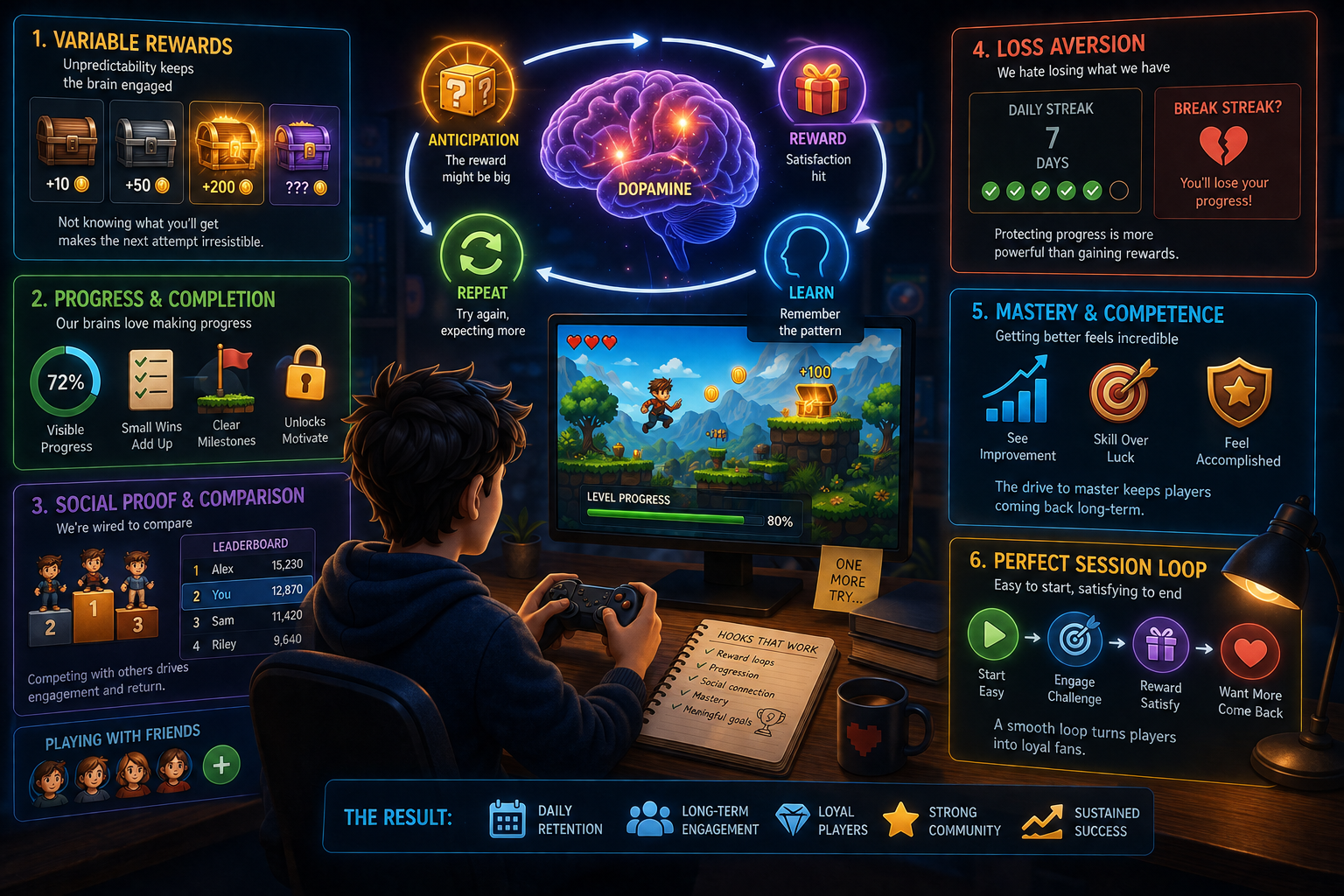
If a game rewarded players the exact same amount every single time, engagement would flatten out fast. The brain responds far more strongly to unpredictable rewards than to consistent ones. This is the same mechanism that makes slot machines compelling, not because the payout is large, but because the timing and size of the payout is never quite certain.

Games that build in variability, slightly different rewards for similar actions, occasional bigger wins mixed into smaller ones, tap into this response naturally. It’s not manipulation by itself. It’s simply how attention and motivation work at a neurological level.

Near Misses Keep People Engaged

A loss that feels close to a win produces a stronger urge to try again than a loss that feels far off. This is why games that occasionally put players one step away from success, rather than failing them outright, tend to generate more replay attempts than games with flat, predictable outcomes.

The Pull of Incremental Progress

Visible Progress Bars Create Momentum

Something as simple as a progress bar nearing completion creates a psychological pull to finish it. Stopping right before a visible milestone feels worse than stopping at a random point, which is exactly why so many games place small, visible goals just within reach at almost every moment.

The Zeigarnik Effect in Practice

People remember and feel pulled toward unfinished tasks more than completed ones. A game that ends a session on an unresolved goal, one more level, one more upgrade just out of reach, leverages this tendency directly. That slight discomfort of incompleteness is often what brings a player back sooner than they’d planned.

Social Proof and Comparison

Leaderboards Tap Into Status Motivation

Humans are wired to care about relative standing, not just absolute performance. A leaderboard turns a personal activity into a social one, and the desire to move up even a single rank can be more motivating than the underlying mechanic itself. Games like Royal Showdown use this directly, the competitive framing gives players a reason to keep playing that goes beyond the base mechanic, driven by wanting to beat a specific opponent rather than just improve a personal score.

Beating a Friend Hits Differently Than Beating a Stranger

Competing against someone you know activates a stronger emotional response than an anonymous leaderboard entry. This is part of why multiplayer and friend-comparison features tend to drive far more repeat engagement than solo score-chasing alone.

Loss Aversion Is a Powerful Motivator

Fear of Losing Progress

People are more motivated to avoid losing something they already have than to gain something new of equal value. Games that let players build up a streak, a collection, or a status, then put that accumulated progress at risk, tap into a stronger psychological pull than pure reward systems alone.

Why Streaks Work

A daily streak feels valuable not because of what it directly unlocks, but because breaking it feels like a loss. This asymmetry, protecting what you have feeling more urgent than acquiring something new, is one of the most reliable psychological levers in game design.

Mastery and Competence

The Satisfaction of Getting Better

Beyond external rewards, there’s a deep, internal satisfaction in noticing your own skill improve. Games that give players a clear, visible sense of increasing competence, faster reaction times, higher scores through actual skill rather than luck, tap into intrinsic motivation that doesn’t depend on external rewards at all.

Difficulty That Matches Growing Skill

If challenge scales too slowly, competence stops feeling meaningful. If it scales too quickly, frustration replaces satisfaction. Getting this balance right is what keeps the sense of mastery feeling earned rather than either trivial or impossible.

Designing Responsibly With These Principles

Understanding psychological hooks doesn’t mean every design choice should exploit them without regard for player wellbeing. There’s a real difference between building a game that’s satisfying because the core loop is genuinely well-crafted, and building one that manipulates anxiety or compulsive behavior purely to maximize time spent.

The strongest, most enduring games tend to lean on the healthier end of this spectrum: variable rewards tied to genuine skill, progress that reflects real improvement, social comparison that feels fun rather than stressful. The manipulative end of these techniques might spike short-term engagement, but it tends to produce resentment and churn once players notice how the game is designed to make them feel.

How This Plays Out in Practical Game Design

Building Feedback Loops That Feel Good

Every action should have a response, visually, audibly, or through some form of progress, so players always understand what just happened. This isn’t manipulation, it’s simply clear communication that happens to also feel satisfying.

Testing Reward Timing

Small adjustments to how often and how much a game rewards players can dramatically change how engaging it feels, often more than a change to the core mechanic itself. This is part of why fast iteration matters so much in design. Create a game platforms make it realistic to test these adjustments quickly, since tuning reward timing usually takes several rounds of trial and error to get right, not a single guess that happens to land perfectly the first time.

Balancing Social Features Carefully

Competitive and comparison features drive engagement effectively, but they can also create pressure that pushes some players away entirely if the gap between skill levels feels too wide. Matching players appropriately, or giving multiple ways to feel successful beyond raw rank, keeps social motivation from tipping into discouragement.

Final Thoughts

The pull of an addictive game rarely comes down to a single feature. It’s the layering of several psychological mechanisms, unpredictable rewards, visible progress, social comparison, loss aversion, and genuine mastery, working together consistently across every session.

Understanding these principles gives any creator a real advantage, not to manipulate players, but to build systems that genuinely respect how motivation works. The games that keep people coming back for years, rather than days, tend to be the ones that use these psychological levers to create something players actually want to return to, not just something they feel compelled to.
Similar Posts

Leave a Reply

Your email address will not be published. Required fields are marked *