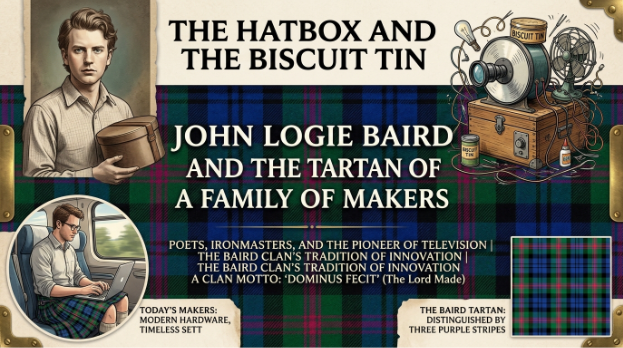
The Hatbox and the Biscuit Tin: John Logie Baird and the Tartan of a Family of Makers
The story of the Baird tartan is tied to an old Scottish family whose tradition of making things stretches from poets and ironmasters to one of the pioneers of television. In the summer of 1923, in an attic room above a shop in Hastings, on the south coast of England, a thin Scotsman with poor health and no money was trying to send a picture through the air.
His apparatus filled a table. The base was an old tea chest. The scanning disc was cut from a hatbox lid. The motor came from an electric fan. The lenses were from bicycle lamps, bought for fourpence each. There were darning needles, a biscuit tin, sealing wax, string, and a great quantity of glue. The whole thing hummed and rattled and occasionally caught fire.
One afternoon that autumn he touched a live connection carrying two thousand volts and was thrown across the room. He came round, unhurt, and the landlord asked him to leave.
His name was John Logie Baird. Within three years he would be the most famous inventor in Britain.
Stooky Bill
Baird was born in Helensburgh, on the Clyde, in 1888, the son of the parish minister. He was ill all his life, with chest complaints that kept him out of the army in 1914, and he had failed at almost everything he tried. He had sold socks, jam and soap. He had gone to Trinidad to make preserves, and come back. He was thirty-five, and he had decided that television, which many serious scientists thought impossible, was going to be his.
From Hastings he moved to two rooms in Frith Street, in Soho, and rebuilt the machine. On 2 October 1925 he pointed it at a ventriloquist’s dummy he called Stooky Bill and saw, on his receiver in the next room, the dummy’s face: not a shadow, a face, with light and shade. He ran downstairs to the office below and dragged up the office boy, a lad of twenty named William Taynton, sat him in front of the disc under blazing lamps, and paid him half a crown to keep still. Taynton was the first human being ever to be televised.
On 26 January 1926 Baird gave the first public demonstration of true television, to a group of members of the Royal Institution crowded into his Soho rooms. Within a few years he had sent pictures by telephone line from London to Glasgow, then across the Atlantic by radio, and had made the first television in colour. The BBC broadcast his system. He lost the technical war in the end, to an electronic system that did not need spinning discs, and he died in 1946, still inventing, still not rich. But the thing itself was his, and he had built the first one out of rubbish in a rented attic.
Bards or eagles
The Bairds are an old Lowland and north-eastern family, and what they were doing before they invented television is a mixture of record and legend.
The name is found in Lanarkshire from the thirteenth century, and one tradition derives it from the Gaelic word for a poet, bàrd, so that the Bairds would be a family of makers of another kind. Their main line settled in Aberdeenshire, at Auchmedden, on the cliffs near Pennan, and it is there that the clan’s best story belongs. Thomas the Rhymer, the thirteenth-century prophet, is supposed to have foretold that eagles would nest in the crags of Auchmedden for as long as there were Bairds in it. The story runs that when the estate passed out of the family in the eighteenth century the eagles left, that they came back when a Baird married in, and that they left again when the line failed. It is a legend, and a good one, and the Aberdeenshire coast does have eagles.
The clan’s motto is Dominus fecit, the Lord made, and its crest is a griffin’s head. It is a family of engineers as much as of poets: apart from the inventor there were the Bairds of Gartsherrie, the ironmasters whose furnaces helped build industrial Scotland.
Three stripes, once red
Their tartan is a modest and rather elegant one. The archives record that it was first published in W. & A. K. Johnston’s collection of 1906 and that a sample in the Highland Society of London’s collection probably dates from the same period. It is a dark cloth: broad bands of blue, black and green, in the family of the Government sett, with one distinguishing feature, a group of three fine stripes running through the blue. In the early references those three stripes were red. Today, the register notes, they are generally woven in purple, which gives the tartan a cool, slightly unexpected note against the navy.
Retailers offer Baird tartan made to order as kilts, skirts, scarves and ties, or by the yard, in Modern and Ancient colours. Clan literature sometimes calls the sett Baird Hunting, which tells you what kind of cloth it is: dark, practical, good with tweed, and not given to display.
That makes it a natural choice for the family’s other tradition, which is making things work.
Helensburgh, a Tuesday morning
Fraser Baird is thirty-one, a software engineer, and he grew up in Helensburgh three streets from the house where the inventor was born. There is a memorial to Baird on the seafront, and a small boy who is told that a man from this town invented television does not forget it.
He commutes to Glasgow on the train, works in a converted warehouse in the Merchant City with forty other engineers, and dresses, as they all do, like a man who does not think about clothes. Except that three days a week he does it in a kilt.
It is not his father’s kilt, which is a fine heavy thing in the Baird tartan that comes out for weddings and would be absurd on the 7.52. It is what the trade has started calling a contemporary kilt, and he bought it from Scottish Kilt, whose range of modern kilts is described as having lighter construction, shallower pleating and modern hardware, in real tartan setts, in a cut you can wear on an ordinary Tuesday.
That description was what sold him, because he is an engineer and he liked the spec. Five yards of cloth rather than eight, so it weighs about what a pair of jeans weighs. Pleats that are shallower and stitched further down, so it sits neatly on a train seat. A lower rise, closer to where trousers sit. Snap fastenings and a single strap instead of three buckles, so it goes on in ten seconds. Pockets, which the traditional kilt never had and which for a man with a phone, a badge and a set of keys are not optional. And a washable yarn, because the traditional answer to a coffee spill on eight yards of worsted is a specialist cleaner, and the modern answer is a washing machine.
It is still, unmistakably, a kilt, cut to his own waist, hips and length in the family sett, with the three purple stripes running through the blue. He wears it with a plain grey T-shirt, a black hoodie, thick socks pushed down and trainers, and in the Merchant City that reads as clothes and not costume. Two other people in the office have since bought one.
He has one rule of his own, which is that a modern kilt does not get modern nonsense with it. No novelty sporran, no rugby shirt, no ghillie brogues with trainer socks. A plain top, plain socks, plain boots or trainers, and the tartan does the talking. The engineer’s principle: remove everything that is not doing a job.
A visiting product manager from San Francisco, who has been told that Fraser is the one to ask about the office, asks instead about the kilt.
“Baird. Same as the man who invented the television.”
“Wait, seriously? Baird, like, that Baird?”
“Same name. He grew up in my town. Built the first one out of a hatbox and a biscuit tin and bicycle lenses in an attic in Hastings. Electrocuted himself. Landlord chucked him out.” Fraser looks down at the snaps on his kilt. “This one’s got modern hardware. He’d have approved. He was a man who liked a good fastening.”
Dominus fecit
The Bairds have been makers for a long time: poets by legend, ironmasters by trade, and, in one sickly minister’s son with no money, the maker of the machine that changed the twentieth century more than any other. He built it from what was lying about, because that was what he had, and he built it to work.
Their tartan is dark and useful and has three purple lines through it that used to be red. Cut light, with pockets and snaps, and worn on the train to a job writing code, it is exactly the kind of thing the man from Helensburgh would have taken apart to see how it was made.