Chicago Bulls vs Lakers Match Player Stats
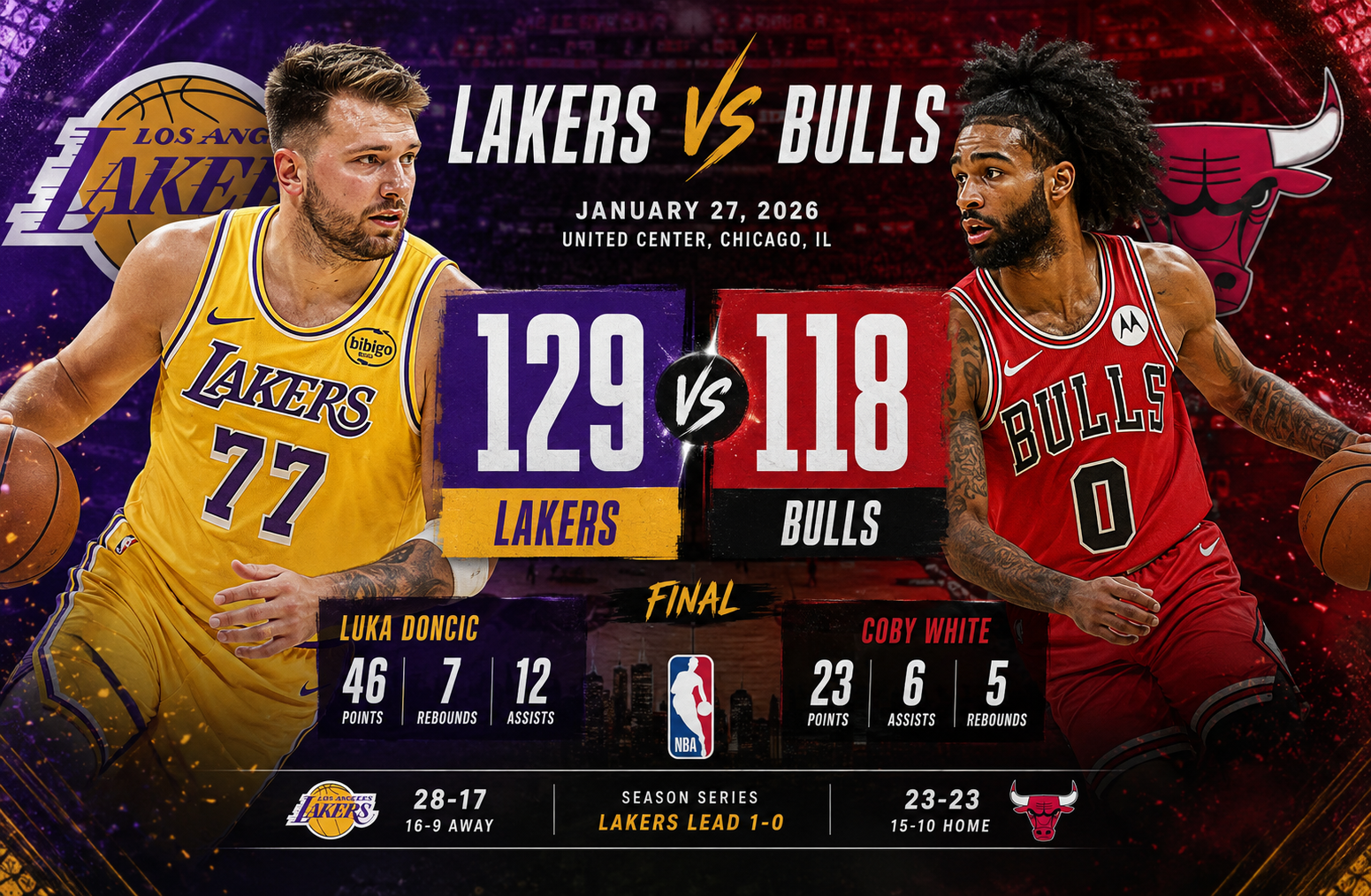
The chicago bulls vs lakers match player stats from the January 2026 meeting tell a much clearer story than the 129-118 final score alone. Los Angeles won at the United Center behind a remarkable 46-point performance from Luka Dončić, while Chicago received strong scoring contributions from Coby White, Nikola Vučević, Josh Giddey, and several other players. The Lakers also benefited from efficient shooting, particularly from three-point range, and did a better job protecting possessions. The official NBA box score confirms the Lakers finished 46-for-82 from the field and 16-for-33 from three, while Chicago went 43-for-82 overall and 18-for-49 from deep.
Chicago Bulls vs Lakers Match Player Stats
The Lakers defeated the Bulls 129-118 in a high-scoring game at the United Center. Although Chicago scored 118 points and shot 52 percent from the field, Los Angeles was more efficient and produced the game’s most decisive individual performance.
Luka Dončić finished with 46 points, seven rebounds, and 12 assists while shooting 15-for-25 from the field and 8-for-14 from three-point range. His combination of scoring efficiency and playmaking made him the central reason Los Angeles controlled the game. The official NBA game page lists Dončić as the leader in points, rebounds, and assists for the Lakers.
LeBron James added 24 points in 33 minutes, while Rui Hachimura scored 23 points on an exceptional 9-for-11 shooting performance. For Chicago, Coby White led the team with 23 points, Nikola Vučević recorded 18 points and 11 rebounds, and Josh Giddey contributed 19 points, six rebounds, and seven assists.
Game Summary at a Glance
| Category | Lakers | Bulls |
| Final Score | 129 | 118 |
| Q1 | 35 | 31 |
| Q2 | 34 | 25 |
| Q3 | 35 | 33 |
| Q4 | 25 | 29 |
| Field Goals | 46-82 | 43-82 |
| Field Goal % | 56% | 52% |
| 3-Pointers | 16-33 | 18-49 |
| 3PT % | 48% | 37% |
| Free Throws | 21-29 | 14-18 |
| Rebounds | 35 | 40 |
| Assists | 26 | 31 |
| Turnovers | 6 | 15 |
| Steals | 7 | 5 |
| Blocks | 3 | 0 |
The numbers show an interesting contrast. Chicago won the rebounding battle and recorded more assists, but Los Angeles protected the ball far better. The Lakers committed only six turnovers compared with 15 by Chicago. That 9-turnover difference was one of the less glamorous but more important statistical advantages of the night.
How the Lakers Won the Game
The simplest explanation is Luka Dončić’s scoring. The deeper explanation is that Los Angeles combined elite shot-making with efficient possession management.
The Lakers shot 56 percent from the field. They also made 16 of 33 three-point attempts, good for approximately 48 percent. Chicago actually made more three-pointers, hitting 18, but needed 49 attempts to do it.
That difference matters.
Chicago’s 18-for-49 performance from outside produced 36 points. Los Angeles‘ 16-for-33 produced 48 points. In other words, the Lakers made two fewer threes but generated 12 more points from three-point attempts because they were dramatically more efficient.
This is one of the most useful lessons from these Chicago Bulls vs Lakers match player stats. Looking only at the number of three-pointers made can hide the quality of the shooting.
The Turnover Gap Was Critical
Chicago recorded 15 turnovers while Los Angeles had only six.
That means the Bulls gave away nine more possessions than the Lakers.
In a game decided by 11 points, that is significant.
The Lakers did not need to dominate the glass or assists to win. Instead, they avoided empty possessions and converted their offensive opportunities at a higher rate.
The NBA’s official game summary also shows that Los Angeles had 24 fast-break points compared with 19 for Chicago.
When a team shoots 56 percent, limits turnovers, and creates transition opportunities, it becomes difficult to overcome even if the opponent has strong offensive production.
Luka Dončić’s 46-Point Performance
Luka Dončić was the obvious statistical centerpiece.
His final line was:
- 38 minutes
- 46 points
- 15-for-25 field goals
- 8-for-14 three-pointers
- 8-for-12 free throws
- 7 rebounds
- 12 assists
- 3 turnovers
The 46 points came on 25 field-goal attempts, which is particularly important when evaluating the performance. Dončić did not simply accumulate points through an enormous volume of inefficient shots.
He converted 60 percent of his field-goal attempts and approximately 57 percent of his three-point attempts.
His eight made three-pointers were also a major factor. Several of those perimeter shots arrived at moments when Chicago had begun to reduce the Lakers’ lead.
The official NBA recap reported that Dončić scored 20 points in the third quarter alone on 6-for-9 shooting.
That third quarter effectively restored Los Angeles’ control.
Dončić as a Scorer and Playmaker
The most impressive part of his performance was not simply the 46 points.
It was the combination of 46 points and 12 assists.
That meant Chicago had to account for both his scoring and his ability to create opportunities for teammates.
Coby White explained the defensive problem after the game, noting that Chicago tried different coverages, including doubling and blitzing pick-and-roll actions, but Dončić continued to manipulate the defense.
That observation is important because it explains why conventional defensive statistics do not fully capture the problem Chicago faced.
A defense can force a player into difficult decisions, but elite offensive creators can still produce advantages by reading the help defense and finding the open teammate.
LeBron James’ Contribution
LeBron James finished with 24 points, five rebounds, and three assists in 33 minutes.
His shooting line was 9-for-19 from the field, 1-for-4 from three, and 5-for-6 at the free-throw line. He also recorded one steal.
The official box score shows that James scored 20 of his 24 points in the first half.
That first-half production helped Los Angeles build its initial advantage.
James did not need to carry the entire offense because Dončić was creating so much pressure. This is one of the most interesting tactical elements of the matchup. When two high-level creators share the floor, the defense has fewer opportunities to load up against either one.
James’ final plus-minus was -14 despite the Lakers winning by 11, which is a useful reminder that plus-minus should not be interpreted in isolation. Individual plus-minus can be influenced by lineup combinations, substitution patterns, and the specific stretches a player spends on or off the court.
Rui Hachimura’s Efficient Scoring
Rui Hachimura produced one of the quietest but most efficient performances of the game.
He scored 23 points in 29 minutes while going:
- 9-for-11 from the field
- 4-for-5 from three
- 1-for-2 from the free-throw line
- 2 rebounds
- 1 assist
- 1 steal
- 1 block
His 9-for-11 shooting equates to roughly 82 percent from the field.
More importantly, four of his nine made field goals came from three-point range.
That efficiency gave the Lakers another scoring outlet beyond Dončić and James.
Chicago could not focus entirely on Dončić because the Lakers had other players capable of punishing defensive rotations.
Marcus Smart’s Role
Marcus Smart scored 12 points in 32 minutes.
He shot 3-for-6 from the field, 1-for-3 from three, and 5-for-7 from the free-throw line.
His scoring total was not spectacular, but his contribution should not be evaluated only through points.
Smart also had two rebounds, one assist, one steal, and no turnovers in the supplied statistical line. The official ESPN box score lists him at +5 for the game.
That is a useful example of why player evaluation requires more than a scoring column. A guard can influence a game through defense, physicality, ball security, and creating difficult possessions even when he is not one of the leading scorers.
Jake LaRavia’s All-Around Minutes
Jake LaRavia played 33 minutes and recorded eight points, five rebounds, three assists, and three steals.
He shot 3-for-6 from the field and 2-for-4 from three.
His three steals were especially notable because they contributed to Los Angeles’ defensive activity without requiring high offensive usage.
The official box score records LaRavia at -9, again showing why one statistic cannot explain an entire performance.
Deandre Ayton’s Numbers
Deandre Ayton played 22 minutes and finished with six points and two rebounds on 3-for-6 shooting.
His offensive workload was relatively limited compared with the Lakers’ primary creators.
The official NBA box score confirms the six-point performance and 22-minute appearance.
The Lakers did not need a major scoring night from Ayton because their perimeter creators were generating enough offense.
Chicago Bulls Player Performance
Chicago’s offensive output was spread more evenly than Los Angeles’.
The Bulls had six players reach double figures according to the official game recap.
That balance helped Chicago remain competitive, but the team could not match Los Angeles’ efficiency.
Coby White Leads Chicago
Coby White finished with 23 points, five rebounds, and six assists.
His shooting line was:
- 8-for-13 from the field
- 5-for-10 from three
- 2-for-2 from the free-throw line
- 4 turnovers
- 1 steal
White shot approximately 61.5 percent from the field and 50 percent from three.
He was therefore one of Chicago’s most efficient offensive players.
His six assists also demonstrate that he was contributing as a creator rather than functioning strictly as a scorer.
White’s postgame comments about Dončić were especially revealing. He acknowledged that Chicago tried multiple defensive approaches but struggled because Dončić could exploit whichever option the defense left available.
Nikola Vučević’s Double-Double
Nikola Vučević posted 18 points and 11 rebounds, giving Chicago one of its strongest interior performances.
He shot 6-for-10 from the field and 5-for-5 from the free-throw line.
He also added five assists, two turnovers, and one steal.
The combination of 18 points, 11 rebounds, and five assists shows why Vučević remained an important offensive hub for Chicago.
His passing was particularly valuable because the Bulls finished with 31 assists as a team.
However, Chicago’s 15 turnovers prevented that ball movement from translating into enough overall offensive efficiency.
Josh Giddey’s Versatile Performance
Josh Giddey scored 19 points with six rebounds and seven assists.
His line included:
- 28 minutes
- 19 points
- 6-for-14 field goals
- 3-for-8 three-pointers
- 4-for-4 free throws
- 6 rebounds
- 7 assists
- 3 turnovers
Giddey was one of Chicago’s most versatile contributors.
His seven assists tied the highest individual assist total among the Bulls’ listed players, while his six rebounds added value on the glass.
The challenge was efficiency. He made 6 of 14 field-goal attempts, which is approximately 42.9 percent.
That is not poor in isolation, but the Lakers’ 56 percent team shooting created a large efficiency gap.
Matas Buzelis Adds Secondary Production
Matas Buzelis finished with 11 points, five rebounds, and four assists in 22 minutes.
He shot 4-for-8 from the field and 2-for-6 from three.
Buzelis also committed three turnovers.
His performance showed some of the upside Chicago received from its secondary contributors, but the turnover count was another part of the broader possession problem.
Isaac Okoro’s Playmaking Contribution
Isaac Okoro scored seven points but added five assists.
He shot 3-for-5 from the field and 1-for-2 from three.
His five assists were significant because they show that his role was not limited to scoring.
Chicago received useful passing contributions throughout the lineup, which helped produce 31 total assists.
The problem was that those advantages were partly canceled by the Bulls’ 15 turnovers.
Patrick Williams’ Limited Minutes
Patrick Williams played 12 minutes and scored seven points.
He went 3-for-5 from the field and 1-for-3 from three while committing one turnover.
His shooting was efficient during his limited time on the court, but the relatively small sample means his individual efficiency should not be treated as representative of a full-game offensive role.
Jalen Smith’s Shooting Efficiency
Jalen Smith played 37 minutes and scored 13 points.
He shot 5-for-7 from the field and 3-for-5 from three, while collecting seven rebounds and one steal.
That was an efficient scoring performance.
Smith’s 5-for-7 shooting translated to approximately 71 percent from the field, while his three-point shooting was 60 percent.
Yet Chicago still lost despite several highly efficient individual shooting performances.
That is an important lesson from the chicago bulls vs lakers match player stats. Basketball games are not decided by one player’s field-goal percentage. Team-level efficiency, turnovers, defensive stops, shot volume, and lineup performance all interact.
Comparing the Team Offenses
The team shooting numbers provide perhaps the clearest statistical explanation for the final result.
Field Goal Efficiency
Los Angeles:
46-for-82, 56 percent
Chicago:
43-for-82, 52 percent
Both teams attempted exactly 82 field goals.
That makes the comparison especially clean.
Los Angeles made three more field goals on the same number of attempts.
Those additional made shots accounted for six points before considering three-point value.
Three-Point Efficiency
Chicago actually made more three-pointers:
18 compared with 16.
But Los Angeles attempted only 33 threes while Chicago attempted 49.
The Lakers converted 48 percent of their attempts.
The Bulls converted approximately 37 percent.
This is a classic example of shot efficiency outperforming raw shot volume.
Chicago’s willingness to shoot from outside kept the offense dangerous, but the lower percentage meant that the extra attempts did not generate enough additional scoring.
Free Throws
Los Angeles went 21-for-29 from the free-throw line.
Chicago went 14-for-18.
Chicago had the better free-throw percentage, approximately 78 percent compared with Los Angeles at approximately 72 percent.
But Los Angeles attempted 11 more free throws and made seven more.
That created another meaningful scoring advantage.
Rebounding Did Not Save Chicago
The Bulls won the rebounding battle 40-35.
Vučević’s 11 rebounds and several contributions from Chicago’s supporting players helped produce that advantage.
Normally, a five-rebound edge can be meaningful.
But rebounding alone could not compensate for the Lakers’ shooting efficiency and turnover advantage.
This is another reason that reading a box score requires context.
If Chicago had converted its 49 three-point attempts at a higher percentage or reduced its turnovers, the rebounding advantage could have become more important.
Instead, Los Angeles turned its superior efficiency into a comfortable winning margin.
The Assist Numbers Tell an Interesting Story
Chicago recorded 31 assists.
Los Angeles recorded 26.
At first glance, that might suggest the Bulls moved the ball better.
They did generate more assists, but assists are only useful when the possessions end efficiently.
The Bulls committed 15 turnovers.
The Lakers committed six.
Therefore, Chicago’s five-assist advantage came alongside a nine-turnover disadvantage.
This is a perfect example of why a single positive statistic cannot be separated from the rest of the box score.
Quarter-by-Quarter Breakdown
The Lakers started quickly.
First Quarter
Los Angeles scored 35 points.
Chicago scored 31.
The four-point Lakers advantage established the early pattern of a high-scoring game.
Second Quarter
Los Angeles extended its advantage with a 34-point quarter compared with 25 for Chicago.
That nine-point difference pushed the halftime margin to 13.
The Lakers entered halftime ahead 69-56.
The official NBA recap noted that Los Angeles built its advantage through a 25-6 run spanning the late first quarter and second quarter.
Third Quarter
Chicago fought back.
The Bulls scored 33 points, while Los Angeles scored 35.
Although Chicago remained aggressive, the Lakers continued producing enough offense to keep the lead.
Dončić’s 20-point third quarter was the defining individual stretch.
Fourth Quarter
Chicago actually outscored Los Angeles 29-25 in the final quarter.
That demonstrates that the Bulls did not simply stop competing.
The problem was that the earlier deficit was too large.
Los Angeles entered the fourth quarter with a 104-89 advantage and maintained enough separation to secure the 129-118 victory.
The Biggest Statistical Differences
Several numbers stand above the rest when analyzing the game.
1. Lakers Field Goal Percentage
Los Angeles shot 56 percent.
Chicago shot 52 percent.
The four-percentage-point difference mattered because both teams attempted the same number of field goals.
2. Lakers Three-Point Efficiency
Los Angeles made 48 percent of its threes.
Chicago made approximately 37 percent.
That difference was worth 12 points despite Chicago making two more three-pointers.
3. Turnovers
Lakers: 6
Bulls: 15
The nine-turnover difference gave Los Angeles considerably better possession efficiency.
4. Dončić’s Shot Creation
Dončić scored 46 points and added 12 assists.
That combination forced Chicago to defend multiple offensive outcomes on almost every possession involving him.
5. Chicago’s Rebounding Advantage
The Bulls collected 40 rebounds to Los Angeles’ 35.
This was a genuine Chicago strength, but it was not enough to overcome the shooting and turnover gaps.
What the Game Says About Individual Player Stats
A box score is most useful when it answers a question.
For example, if the question is who scored the most, Dončić is the obvious answer.
- If the question is who shot most efficiently among major scorers, Hachimura stands out.
- If the question is who produced the strongest all-around Bulls line, Vučević and Giddey deserve attention.
- If the question is which team protected possessions better, the Lakers clearly win.
- If the question is which team rebounded better, Chicago wins.
This approach is more useful than simply listing numbers.
Best Lakers Performances
Luka Dončić: 46 points, 7 rebounds, 12 assists
LeBron James: 24 points, 5 rebounds, 3 assists
Rui Hachimura: 23 points on 9-for-11 shooting
Marcus Smart: 12 points, 2 rebounds, 1 steal
Jake LaRavia: 8 points, 5 rebounds, 3 assists, 3 steals
Best Bulls Performances
Coby White: 23 points, 5 rebounds, 6 assists
Josh Giddey: 19 points, 6 rebounds, 7 assists
Nikola Vučević: 18 points, 11 rebounds, 5 assists
Jalen Smith: 13 points, 7 rebounds
Matas Buzelis: 11 points, 5 rebounds, 4 assists
Why the Final Score Can Be Misleading
A final score of 129-118 suggests a fairly comfortable Lakers victory.
That is accurate, but it does not describe the entire flow.
Chicago reduced the deficit substantially during the third quarter. The Bulls closed to 81-80 with 6:42 remaining in the third after Vučević converted two free throws.
That was a critical moment.
The Lakers responded immediately.
Marcus Smart produced a three-point play, Dončić converted two free throws, and Hachimura hit a three-pointer as Los Angeles rebuilt its advantage.
This sequence illustrates the importance of shot creation during momentum swings.
Chicago had done enough to get within one.
Los Angeles had the offensive firepower to respond.
What Chicago Did Well
Despite the defeat, there were several positive elements in the Bulls’ performance.
First, Chicago shot 52 percent overall.
Second, six Bulls reached double figures.
Third, the team won the rebounding battle.
Fourth, Chicago produced 31 assists.
Fifth, the Bulls continued attacking offensively after falling behind.
These are not signs of an offense that completely collapsed.
The problem was that the positive elements were outweighed by inefficient three-point shooting and excessive turnovers.
What Chicago Needed to Improve
The clearest improvement area was possession management.
Fifteen turnovers against a team that committed only six created a difficult path to victory.
The second issue was three-point selection and efficiency.
Chicago attempted 49 three-pointers, nearly half of its 82 field-goal attempts.
That approach can work when the shots fall.
Against Los Angeles, 18 made threes were not enough because 31 attempts missed.
The third issue was containing Dončić without creating excessive defensive rotations.
Chicago’s own players acknowledged how difficult it was to remove every option from his offensive game.
What the Lakers Did Well
Los Angeles executed the fundamentals at a high level.
The Lakers:
- Shot 56 percent overall
- Shot 48 percent from three
- Committed only six turnovers
- Produced 26 assists
- Scored 24 fast-break points
- Received 93 combined points from Dončić, James, and Hachimura
That last figure is especially important.
Dončić scored 46.
James scored 24.
Hachimura scored 23.
Together, they accounted for 93 of Los Angeles’ 129 points.
That is roughly 72 percent of the team’s scoring.
The Lakers therefore received an enormous amount of production from their top offensive weapons while also avoiding major possession losses.
How to Use These Stats for Player Evaluation
For fans, fantasy basketball players, analysts, and writers, the best way to use a box score is to combine basic statistics with context.
Start with points, rebounds, and assists.
Then examine shooting volume and efficiency.
Next, look at turnovers.
After that, compare three-point attempts with three-point percentage.
Finally, consider game flow.
This prevents a common mistake: declaring a player excellent simply because he scored a lot of points.
Dončić’s 46 points are impressive because they came with 15-for-25 shooting and 12 assists.
Hachimura’s 23 points are notable because he needed only 11 field-goal attempts.
White’s 23 points are valuable because he also contributed six assists.
Vučević’s 18 points become more meaningful when paired with 11 rebounds and five assists.
That is how raw box-score numbers become meaningful basketball analysis.
Official Source for Verification
For readers who want to verify the complete box score, quarter-by-quarter scoring, player shooting numbers, game information, and play-by-play details, the best primary reference is the official NBA game box score.
The NBA record confirms the 129-118 final score, the 46-point performance by Dončić, the 21,298 attendance figure, and the complete statistical breakdown.
Frequently Asked Questions
What was the final score of the Lakers vs Bulls game?
The Los Angeles Lakers defeated the Chicago Bulls 129-118 at the United Center.
Who scored the most points in the game?
Luka Dončić led all players with 46 points. He also recorded seven rebounds and 12 assists.
Who led the Bulls in scoring?
Coby White led Chicago with 23 points. He also recorded five rebounds and six assists.
How many points did LeBron James score?
LeBron James scored 24 points in 33 minutes. He shot 9-for-19 from the field and 5-for-6 from the free-throw line.
How many rebounds did Nikola Vučević have?
Nikola Vučević recorded 11 rebounds along with 18 points and five assists.
Which team shot better from three-point range?
The Lakers shot better from three. Los Angeles made 16 of 33 attempts, approximately 48 percent, while Chicago made 18 of 49, approximately 37 percent.
Conclusion
The chicago bulls vs lakers match player stats reveal a game in which Los Angeles won through superior shooting efficiency, outstanding individual shot creation, and excellent ball security.
Luka Dončić was the defining performer. His 46 points, seven rebounds, and 12 assists gave the Lakers a scoring and playmaking advantage that Chicago could not consistently contain.
LeBron James supplied 24 points, while Rui Hachimura added 23 points on highly efficient shooting. Those performances meant Los Angeles did not need Dončić to carry every possession by himself.
Chicago had plenty of strong individual numbers. Coby White scored 23 points, Josh Giddey produced 19 points and seven assists, and Nikola Vučević recorded 18 points and 11 rebounds. The Bulls also won the rebounding battle and finished with more assists.
However, the most important team-level differences were efficiency and turnovers. The Lakers shot 56 percent from the field and 48 percent from three while committing only six turnovers. Chicago shot 52 percent overall, approximately 37 percent from three, and committed 15 turnovers.
The result was a useful reminder that basketball games are decided by the interaction of statistics rather than by one category. Chicago had more rebounds, more assists, and more made three-pointers. Los Angeles still won because it converted its opportunities more efficiently and gave away far fewer possessions.
For anyone studying this matchup, the most revealing numbers are therefore not simply the 129-118 score or Dončić’s 46 points. The deeper story is the combination of elite shot-making, possession control, three-point efficiency, and timely responses whenever Chicago threatened to take control.