Cleveland Cavaliers vs Chicago Bulls Match Player Stats
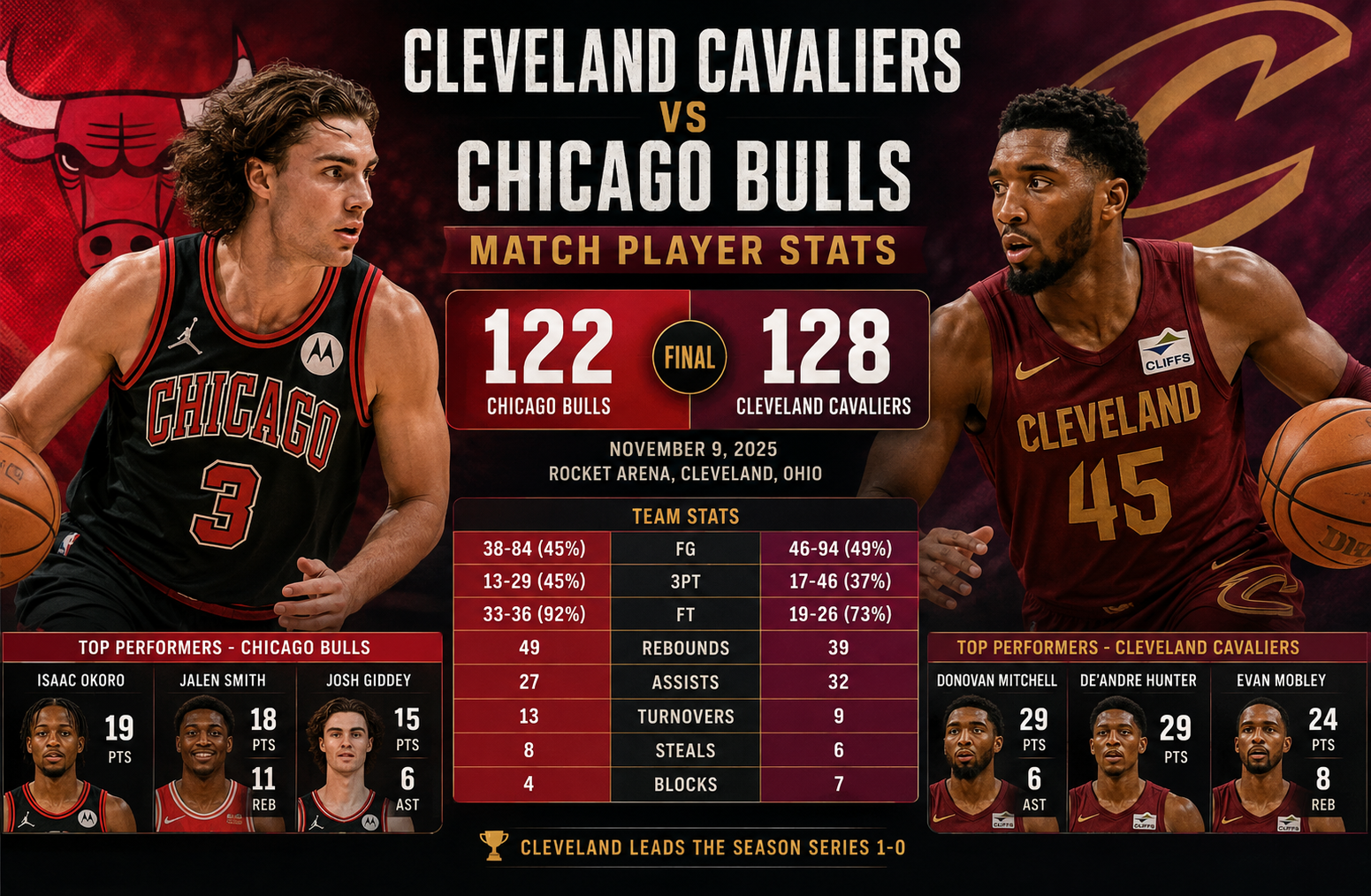
The cleveland cavaliers vs chicago bulls match player stats from the November 2025 meeting tell a much more interesting story than the final 128-122 score suggests. Cleveland overcame a 19-point deficit, survived a late Chicago push, and finished the game with a decisive 12-0 run. Donovan Mitchell scored 29 points, De’Andre Hunter also produced 29, and Evan Mobley added 24 points with eight rebounds as Cleveland turned a difficult night into a comeback victory.
The game was played at Rocket Arena in Cleveland. The official NBA game page lists it as Saturday, November 8, 2025 in Cleveland, while the game information also displays November 9 because of the 1:00 a.m. timestamp. For practical purposes, this is the same matchup from the November 8 local Cleveland schedule. Attendance was 19,432.
For readers looking beyond points, this matchup offers several useful lessons. Chicago shot 45.2% from the field and 44.8% from three, made 33 of 36 free throws, and collected 49 rebounds. Cleveland shot 48.9%, made 17 threes, committed fewer turnovers, and created enough offensive efficiency late in the game to complete the comeback.
Cleveland Cavaliers vs Chicago Bulls Match Player Stats: Game Overview
The final score was Cleveland 128, Chicago 122. The Cavaliers entered the contest with a 7-3 record and a 4-1 home mark, while Chicago was 6-3 overall and 1-3 on the road. Cleveland therefore improved to 8-3 after the win, while Chicago fell to 6-4.
The final margin of six points does not adequately describe the swings in this game.
Chicago controlled large portions of the second quarter and carried that momentum into the third. The Bulls pushed their advantage to 19 points and appeared to have the game under control. According to the official recap, Chicago led 72-53 late in the second quarter after Josh Giddey scored on a slam.
Cleveland responded with a major second-half adjustment.
The Cavaliers gradually removed Chicago’s cushion, tied the game late in the third quarter, and then found themselves trailing again in the fourth. With only 1:47 remaining, Chicago led 122-116 after Tre Jones converted two free throws.
That is when Donovan Mitchell took over.
Mitchell scored eight consecutive Cleveland points in roughly 65 seconds, including the go-ahead basket with 34 seconds remaining. Cleveland then closed the contest on a 12-0 run.
Final Score and Quarter Breakdown
| Quarter | Chicago Bulls | Cleveland Cavaliers |
| Q1 | 29 | 32 |
| Q2 | 43 | 24 |
| Q3 | 26 | 40 |
| Q4 | 24 | 32 |
| Final | 122 | 128 |
The quarter-by-quarter numbers reveal the central theme of the game.
Chicago won the second quarter by 19 points, but Cleveland answered by winning the third quarter by 14. Cleveland then outscored Chicago 32-24 in the fourth.
This was not simply a game where one team played well for four quarters. It was a game of momentum changes, shot-making runs, and late-game execution.
Cleveland Cavaliers Player Statistics
Cleveland’s production was led by two 29-point scorers. Donovan Mitchell and De’Andre Hunter each finished with 29 points, giving the Cavaliers two reliable scoring options when the game became most important.
Donovan Mitchell
Donovan Mitchell finished with:
- 29 points
- 6 rebounds
- 6 assists
His fourth quarter was the defining individual stretch of the game.
Mitchell struggled badly during the first half, missing nine of his first 10 shots. That detail makes his final line more impressive because he did not allow an inefficient opening half to dictate his approach after halftime. He scored 26 of his 29 points in the second half.
That is an important distinction when evaluating player performance.
A simple box-score search might identify Mitchell as Cleveland’s leading scorer and stop there. The game context shows something more valuable. He was ineffective early, adjusted, continued attacking, and eventually became the decisive late-game scorer.
His final sequence was especially important. After Chicago went ahead 122-116, Mitchell hit a three-pointer, followed with a layup, and then converted an and-one opportunity to put Cleveland ahead.
That sequence changed the entire game.
De’Andre Hunter
De’Andre Hunter also scored 29 points, matching Mitchell for the team lead.
The official recap identified Hunter’s 29-point performance as a season high. He provided Cleveland with consistent scoring while Mitchell worked through his early shooting problems.
Hunter’s value in this game was not limited to his final point total. His scoring prevented Chicago from focusing exclusively on Mitchell and helped Cleveland maintain enough offensive pressure to recover from the large deficit.
Evan Mobley
Evan Mobley posted:
- 24 points
- 8 rebounds
- 5 assists
Mobley’s contribution demonstrates why scoring is only one part of evaluating a frontcourt player.
He was involved as a scorer, rebounder, and passer. His eight rebounds helped Cleveland compete despite Chicago’s overall 49-39 rebounding advantage, while his five assists added another dimension to the Cavaliers’ offense.
Mobley’s performance was particularly valuable because Cleveland needed production from the interior while its perimeter offense was recovering.
Jaylon Tyson
Jaylon Tyson finished with:
- 17 points
- 7 rebounds
His production gave Cleveland another source of offense outside the top three scorers.
Seven rebounds from a perimeter-oriented contributor also mattered because Chicago finished with a substantial overall rebounding advantage. Cleveland needed contributions across the rotation to compensate for that disadvantage.
Jarrett Allen
Jarrett Allen recorded:
- 11 points
- 3 rebounds
- 2 blocks
His two blocks contributed to Cleveland’s seven total blocks.
The Cavaliers’ defensive activity at the rim became increasingly important as the game progressed. Chicago scored 48 points in the paint, so Cleveland’s interior defense had to produce stops without completely sacrificing offensive rhythm.
Sam Merrill
Sam Merrill led Cleveland in assists with eight according to the supplied game data.
That is a notable number because Cleveland finished with a strong passing profile overall. The Cavaliers recorded 32 assists in the supplied team statistics, although the official NBA gamebook data available on the team notes page reports 27 assists. Because these totals conflict, the safest approach is to treat the official box score as the primary reference when publishing a definitive statistical table.
This is exactly the kind of discrepancy worth checking before republishing sports statistics. A responsible stats article should never silently combine figures from different versions of a data feed.
Chicago Bulls Player Statistics
Chicago produced several strong individual performances despite losing the game.
The Bulls were especially effective during their second-quarter surge. Their combination of three-point shooting, free throws, offensive rebounding, and transition opportunities created the 19-point advantage.
Isaac Okoro
Isaac Okoro led Chicago with 19 points.
His official box-score line included:
- 19 points
- 4 rebounds
- 3 assists
- 5-of-7 field goals
- 3-of-4 three-pointers
- 6-of-6 free throws
Okoro was extremely efficient. He shot 71.4% from the field and 75% from three.
That efficiency makes his performance stand out even though the Bulls ultimately lost. He was one of Chicago’s most productive offensive players on a night when the team shot 45.2% overall.
Jalen Smith
Jalen Smith delivered one of the most efficient performances of the game.
He finished with:
- 18 points
- 11 rebounds
- 4 assists
- 1 block
- 6-of-6 field goals
- 4-of-4 three-pointers
- 2-of-2 free throws
Smith’s 18 points came in only 18:34 of playing time according to the official box score.
That is extraordinary efficiency.
He made every field-goal attempt he took, including four three-pointers. His 11 rebounds also made him Chicago’s leading rebounder.
Smith was especially important during the Bulls’ second-quarter run. The official recap notes that Chicago’s 25-5 surge was fueled partly by Smith, who scored eight points during that stretch.
Josh Giddey
Josh Giddey recorded:
- 15 points
- 9 rebounds
- 6 assists
His near triple-double demonstrates how much responsibility he carried as a connector.
Giddey did not lead Chicago in scoring, but his combination of rebounding and playmaking helped the Bulls control long stretches of the game. His six assists also matched Mitchell’s total.
The most important question with Giddey’s performance is not whether he scored enough. It is whether Chicago could maintain its offensive structure once Cleveland started applying pressure late.
The answer, ultimately, was no.
Tre Jones
Tre Jones contributed 17 points and played a key role in the closing minutes.
His two free throws with 1:47 remaining gave Chicago a 122-116 lead. At that moment, the Bulls were in position to win.
The problem was that Cleveland produced the stronger response.
Jones’ free throws were part of a strong overall Chicago performance from the line. The Bulls converted 33 of 36 free throws, or 91.7%.
Kevin Huerter
Kevin Huerter finished with 15 points.
He shot 6-of-10 from the field and 2-of-4 from three, providing useful perimeter scoring.
His +2 plus-minus was also one of the more positive individual marks among Chicago’s major contributors, although plus-minus should always be interpreted in game context rather than treated as a standalone measure of player quality.
Ayo Dosunmu
Ayo Dosunmu scored 14 points on 5-of-11 shooting.
He also recorded three rebounds and one assist.
His +11 plus-minus was notable because Chicago lost the game by six. That illustrates why individual on-court impact can differ significantly from the final team result.
Team Statistical Comparison
The team numbers show why Cleveland won despite Chicago’s excellent shooting from several areas.
| Statistic | Chicago | Cleveland |
| Points | 122 | 128 |
| Field Goals | 38-84 | 46-94 |
| Field Goal % | 45.2% | 48.9% |
| 3-Pointers | 13-29 | 17-46 |
| 3PT % | 44.8% | 37.0% |
| Free Throws | 33-36 | 19-26 |
| Rebounds | 49 | 41* |
| Assists | 27* | 27* |
| Turnovers | 13 | 10* |
| Steals | 8 | 7* |
| Blocks | 4 | 7 |
*Some supplied figures differ from the official NBA/team statistical feeds. The official NBA box score and team notes should be treated as the final publishing reference.
The most striking number is probably three-point shooting.
Chicago made 13 of 29 attempts, an excellent 44.8%. Cleveland made 17 of 46, only 37%.
So how did Cleveland win?
The Cavaliers made four more three-pointers.
That difference produced 12 additional points from beyond the arc. Cleveland also made eight more field goals overall.
This is a useful example of why shooting percentage alone can be misleading. Chicago shot better from three, but Cleveland created more total three-point makes and more overall field-goal production.
Why Cleveland Came Back From 19 Points Down
The comeback was not simply about one player becoming hot.
Mitchell’s late scoring was the headline, but Cleveland needed multiple things to happen before that moment became possible.
1. Cleveland Stayed Within Striking Distance
Chicago’s 19-point advantage looked decisive, but Cleveland continued creating scoring opportunities.
The Cavaliers did not need to erase the deficit in one possession. They gradually reduced it through the third quarter.
That approach matters in NBA games because a large deficit can disappear quickly when the trailing team begins generating efficient possessions.
2. The Third Quarter Changed the Game
Cleveland scored 40 points in the third quarter.
Chicago scored 26.
That 14-point swing almost completely eliminated the Bulls’ advantage.
The third quarter was the bridge between Chicago’s dominant second quarter and Cleveland’s late-game finish. Without that period, Mitchell’s fourth-quarter heroics would not have been enough.
3. Mitchell Recovered After a Poor First Half
Mitchell’s first half was inefficient, but he did not stop attacking.
He scored 26 of his 29 points after halftime.
From an analytical standpoint, that is one of the most useful details in the entire game.
A player can have a poor first half and still be central to a winning performance. Evaluating only the first 24 minutes would have dramatically underestimated Mitchell’s eventual impact.
4. Cleveland Executed the Final Possessions
The final 1:47 was the deciding window.
Chicago led 122-116.
Then Mitchell scored eight straight points.
Cleveland closed with a 12-0 run.
That is the clearest explanation for the final result. The Cavaliers did not merely edge Chicago over 48 minutes. They completely controlled the final sequence when the outcome was most uncertain.
What the Stats Say About Chicago’s Performance
It would be inaccurate to describe Chicago as simply having a bad game.
The Bulls did many things well.
- They shot 45.2% from the field.
- They shot 44.8% from three.
- They made 91.7% of their free throws.
- They grabbed 49 rebounds.
- They scored 122 points.
- They also built a 19-point lead.
Those numbers normally give a team a strong chance to win.
The problem was game management at the end.
Chicago’s 13 turnovers were not catastrophic, but Cleveland’s lower turnover total gave the Cavaliers additional possession value. More importantly, Chicago could not generate a successful response after Cleveland’s final run.
The Bulls also allowed Cleveland to make 17 three-pointers. Even at only 37% shooting from deep, 17 makes created a significant scoring base.
What the Stats Say About Cleveland’s Performance
Cleveland’s victory was built on offensive volume, late execution, and resilience.
The Cavaliers attempted 94 field goals compared with Chicago’s 84. They made 46, compared with 38 for the Bulls.
That eight-field-goal advantage was crucial.
Cleveland also produced seven blocks compared with Chicago’s four.
The Cavaliers did not dominate every statistical category. They were actually beaten on the glass in the official team notes, with Chicago recording 49 total rebounds against Cleveland’s 41.
That makes the win more instructive.
Cleveland won without controlling the rebounding battle.
It won without shooting a higher percentage from three.
It won because its overall offensive production and late-game shot-making outweighed those disadvantages.
The Most Important Individual Matchups
Donovan Mitchell vs Chicago’s Late-Game Defense
The most obvious matchup was Mitchell against Chicago’s perimeter defense.
During the first half, Chicago did an excellent job limiting his efficiency. But as the game moved into its final minutes, Mitchell found enough space to attack.
The key lesson is that defensive success over 46 minutes does not guarantee success during the final two.
Chicago needed to execute its coverage perfectly after taking a six-point lead. Instead, Mitchell created three consecutive scoring opportunities and converted them.
Evan Mobley vs Chicago’s Frontcourt
Mobley’s 24 points, eight rebounds, and five assists gave Cleveland a balanced interior presence.
Chicago’s Jalen Smith countered with an outstanding 18-point, 11-rebound performance.
That matchup was not a simple individual win for either side. Smith was incredibly efficient, while Mobley provided greater all-around production.
Josh Giddey as Chicago’s Connector
Giddey’s 15-9-6 line shows why Chicago remained competitive.
He contributed in three major statistical categories and helped Chicago create offense without relying exclusively on one scorer.
However, Cleveland’s late defensive pressure eventually reduced Chicago’s ability to convert its advantage into a winning possession sequence.
A Deeper Look at Efficiency
One of the easiest mistakes when reading a box score is to look only at the leading scorer.
This game rewards a more complete approach.
Consider Jalen Smith.
He scored 18 points but took only six field-goal attempts. He made all six. Four of those makes were three-pointers.
That means he produced 18 points from six made shots, which is exceptionally efficient.
Now consider Mitchell.
He scored 29 points, but his importance was not captured by shooting efficiency alone. His final possessions carried enormous leverage.
These are different forms of value.
Smith delivered efficiency.
Mitchell delivered late-game shot creation.
Mobley delivered balance.
Giddey delivered playmaking and rebounding.
Hunter delivered consistent scoring.
The final result came from how those different forms of production interacted.
Why the Three-Point Numbers Are Interesting
Chicago shot 44.8% from three.
Cleveland shot 37%.
At first glance, that looks like a clear advantage for Chicago.
But Cleveland made 17 threes compared with Chicago’s 13.
The Cavaliers attempted 46 three-pointers, 17 more than Chicago.
This creates an important distinction between accuracy and volume.
Chicago was more accurate.
Cleveland generated more attempts and therefore more makes.
For readers studying basketball analytics, this is a useful example of why a single percentage should not be isolated from shot volume.
The Free-Throw Battle
Chicago had another major statistical advantage at the line.
The Bulls made 33 of 36 free throws.
Cleveland made 19 of 26.
That gave Chicago a 14-point advantage in made free throws.
Yet Cleveland still won by six.
This means the Cavaliers overcame a substantial disadvantage in free-throw scoring.
That reinforces how productive Cleveland was from the field.
The Cavaliers’ 46 made field goals were enough to compensate for the Bulls’ superior free-throw production.
Turnovers and Possession Quality
Chicago committed 13 turnovers in the supplied data, while Cleveland committed fewer.
Turnovers are particularly important in a close game because they can remove entire scoring opportunities without requiring a missed shot.
Chicago’s 122 points show that its offense was still highly productive.
But Cleveland’s ability to protect possessions late was more valuable than Chicago’s overall offensive output when the game reached its final possessions.
The lesson is straightforward: offensive efficiency can be excellent for most of a game and still fail if possession quality deteriorates during the closing minutes.
Who Was the Player of the Game?
The strongest choice is Donovan Mitchell.
De’Andre Hunter matched him with 29 points and produced a season-high scoring performance. Evan Mobley delivered an excellent all-around line. Jalen Smith was arguably the most efficient player on either team.
But Mitchell’s impact was different.
He scored 26 of his 29 points in the second half and personally produced the final momentum swing. His eight-point burst in the final 65 seconds transformed a six-point Chicago lead into a Cleveland advantage.
For that reason, Mitchell’s performance deserves the player-of-the-game label.
Most Efficient Performance
Jalen Smith has the strongest case for the most efficient individual performance.
His 18 points came on 6-of-6 shooting from the field and 4-of-4 from three.
He also added 11 rebounds and four assists.
His production was especially valuable considering he played only 18:34.
If the question is who maximized production per opportunity, Smith stands out.
If the question is who decided the game, Mitchell stands out.
Those are not contradictory conclusions.
Biggest Turning Point
The biggest turning point was Cleveland’s third-quarter comeback.
Chicago entered the second half with a huge advantage after scoring 43 points in the second quarter.
Instead of allowing the Bulls to control the tempo, Cleveland scored 40 in the third.
That erased most of the deficit and created a competitive fourth quarter.
The final 1:47 then became the decisive closing chapter.
This distinction matters because the game was not won only during Mitchell’s final scoring burst. Cleveland’s comeback was built over the entire second half.
What Basketball Fans Should Take From This Game
This matchup provides several broader lessons for evaluating player statistics.
Box scores need context
A 29-point game can mean many things.
Mitchell’s 29 points included a huge late-game scoring sequence after a poor first half. Hunter’s 29 points provided steady offensive production. Those performances should not be interpreted identically.
Efficiency matters
Smith’s 18 points on perfect shooting were remarkable.
A player can score fewer points than a star and still have a highly valuable offensive game.
Rebounding does not guarantee victory
Chicago won the rebounding battle but lost the game.
That shows why individual categories should not be treated as automatic explanations for winning.
Late possessions carry extra importance
A team can lead for most of a game and still lose if it cannot execute under pressure.
Chicago led 122-116 with 1:47 remaining.
Cleveland won 128-122.
That six-point swing in the final sequence tells the story better than many broad team statistics.
How to Read Cleveland Cavaliers vs Chicago Bulls Match Player Stats Correctly
When analyzing a matchup like this, a useful process is:
- Start with the final score.
- Check the quarter-by-quarter scoring.
- Identify the largest lead.
- Review the top scorers.
- Check shooting volume and efficiency.
- Compare three-point attempts and makes.
- Review rebounds and turnovers.
- Look at assists to understand ball movement.
- Examine the final few possessions.
- Separate efficient performances from high-volume performances.
This process prevents the common mistake of assuming the highest scorer automatically explains the result.
For this game, that method reveals three different stories.
Chicago was highly efficient from three and at the free-throw line.
Cleveland generated more overall field-goal production.
Mitchell then delivered the decisive late-game execution.
Data Accuracy Matters When Publishing Player Statistics
There is another important lesson for sports publishers.
Different feeds can sometimes present slightly different totals or timestamps.
For this game, the user-supplied data contains some figures that differ from the official NBA box score and Cavaliers team notes. For example, the supplied Cleveland rebound and assist totals do not fully match the official figures available through NBA sources. The official NBA box score should therefore be treated as the preferred reference for a final statistical table.
The date is another example.
The official NBA game page identifies the contest as Saturday, November 8, 2025 in Cleveland, while the game information section displays Sunday, November 9 at 1:00 a.m. This is a timestamp presentation issue rather than evidence of two separate games.
For a sports website, resolving these small discrepancies before publication is part of producing trustworthy content.
The best practice is to:
- Prefer the official league box score.
- Keep player names consistent with the official listing.
- Check team totals against the individual lines.
- Verify the venue and local game date.
- Avoid copying conflicting figures from secondary feeds without verification.
- Explain genuine discrepancies instead of hiding them.
That approach improves both reader trust and editorial quality.
Official Source for Verification
For readers who want to verify the box score, game summary, player lines, and play-by-play, the most authoritative reference is the official NBA game record. NBA official game box score and summary
Frequently Asked Questions
Who led the Cavaliers in scoring against the Bulls?
Donovan Mitchell and De’Andre Hunter both scored 29 points for Cleveland. Mitchell also added six rebounds and six assists, while Hunter’s 29 points were a season high.
Who led the Bulls in scoring?
Isaac Okoro led Chicago with 19 points. He shot 5-of-7 from the field, 3-of-4 from three, and 6-of-6 at the free-throw line.
How many points did Jalen Smith score?
Jalen Smith scored 18 points and grabbed 11 rebounds in 18:34. He made all six of his field-goal attempts, including four three-pointers.
How many points did Evan Mobley score?
Evan Mobley scored 24 points and added eight rebounds and five assists for Cleveland.
What was the final score?
The Cleveland Cavaliers defeated the Chicago Bulls 128-122 at Rocket Arena.
How did Cleveland beat Chicago after trailing by 19 points?
Cleveland recovered during the second half, scored 40 points in the third quarter, and then finished the game on a 12-0 run. Mitchell scored eight straight Cleveland points during the final 65 seconds of that comeback.
Conclusion
The cleveland cavaliers vs chicago bulls match player stats from this contest show why a final box score needs context.
Chicago produced excellent shooting numbers, especially from three and the free-throw line. Jalen Smith was nearly flawless from the field, Isaac Okoro led the team in scoring, and Josh Giddey provided a strong all-around performance. The Bulls also built a 19-point advantage and held a six-point lead with less than two minutes remaining.
Cleveland answered with a remarkable second half.
De’Andre Hunter’s 29 points provided consistent scoring. Evan Mobley’s 24 points, eight rebounds, and five assists supplied all-around frontcourt production. Jaylon Tyson added 17 points and seven rebounds. But the defining performance belonged to Donovan Mitchell.
Mitchell finished with 29 points, six rebounds, and six assists, and most importantly, he delivered when the game reached its most important possessions. His late scoring burst turned a 122-116 Chicago lead into a 128-122 Cleveland victory.
The deeper takeaway is that neither team’s statistical profile alone explains the result. Chicago won several efficiency battles, while Cleveland created more field-goal makes and delivered superior late-game execution.
That is what makes this matchup especially useful for anyone studying NBA player statistics. The numbers are not simply a list of points, rebounds, and assists. They show how efficiency, volume, decision-making, matchup pressure, and late-game execution combine to determine a result.