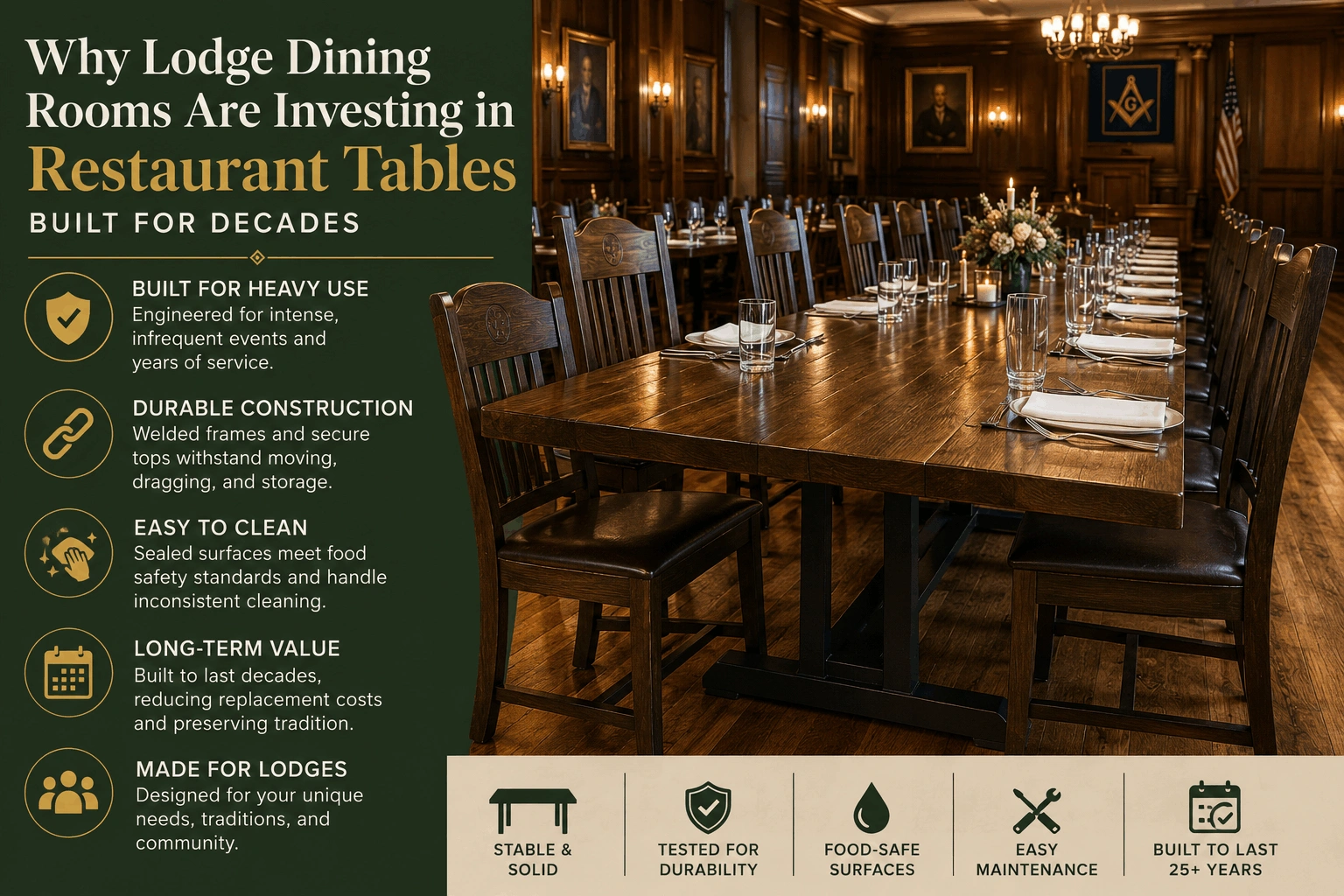
Why Lodge Dining Rooms Are Investing in Restaurant Tables Built for Decades
There is a particular sound a lodge dining room makes on a festive board night. Chairs moving on a wooden floor, forty conversations at once, cutlery, and underneath all of it the low knock of heavy tables that do not shift when somebody leans on them. Most members would struggle to describe the furniture afterward. They would notice immediately if it were replaced with something lighter.
That instinct turns out to be sound economics as well as sentiment. Lodges refurbishing their dining rooms are increasingly buying restaurant tables specified for commercial service rather than the domestic-grade furniture that filled these rooms for a generation. The reasoning is not nostalgia. It is that a lodge uses its dining room in a pattern almost no restaurant matches, and that pattern punishes the wrong furniture in slow, expensive ways.
The Usage Pattern Is Unusual and Hard on Tables
A restaurant table works every day and is maintained by people who are there every day. A lodge table works intensely, then sits.
Twelve to twenty times a year the room is set for a formal dinner, used hard for four hours, cleared late by volunteers, and then left. Between those nights it may be pushed against a wall, used for committee meetings, or stacked in a corner while the room hosts something else. Nobody inspects it. Nobody tightens anything. Nobody is responsible for it in the way a head of maintenance is responsible for a hotel’s furniture, because lodges rarely have one.
That cycle is worse for furniture than daily use. Joints that would be worked and noticed in a restaurant sit loose for months. Tops that would be wiped nightly develop rings that set. Damage accumulates unobserved between events, and the discovery happens when somebody is setting up for a dinner that starts in three hours.
The Long Table Has a Longer History Than the Lodge
This particular piece of furniture is very old, which explains why the instinct to buy heavy is so persistent.
The refectory table, developed for monastic dining halls, was built long and heavy for the same reasons a lodge wants one. It seats a formal company along its length, it doesn’t move when leaned on, and it’s expected to outlast everyone using it. Lodges inherited that form directly, and the rooms were designed around it.
Which is why a lodge that replaces its tables with something modern and light frequently regrets it within two years. The room was proportioned for mass, and lighter furniture reads as temporary in a space full of permanent things.
What Volunteers Do to Furniture
This is the part that separates a lodge from a hospitality venue, and it is not a criticism of anybody.
Tables get moved by whoever is available, which means they get dragged rather than lifted, carried by the top rather than the frame, and set down harder than a paid porter would set them down. Storage is wherever there is room. Nobody is trained, nobody is supervised, and the work happens at eleven at night after a long evening.
Furniture specified for that reality survives it. A welded frame tolerates being dragged. A top that is mechanically fixed rather than glued survives being carried by its edge. Leveling feet that thread into a captive insert can be replaced when they vanish, which they will.
Cleaning Between Events Is Its Own Problem
Lodge dining rooms serve real meals, and the surfaces have to be treated as foodservice surfaces even though nobody thinks of the room that way.
Standards for food equipment are written around materials that are smooth, non-absorbent and genuinely cleanable, because a porous surface in a dining setting is a hygiene problem rather than an aesthetic one. A table that gets used a dozen times a year and cleaned by different people each time needs a surface that forgives inconsistent cleaning.
That argues against untreated timber, however handsome, and toward sealed surfaces that recover from a wipe rather than requiring a technique.
The Money Argument Lodges Respond To
Committees are careful with member funds, which is exactly why the durable option usually wins once somebody does the arithmetic properly rather than comparing two invoices.
Furniture and fixtures are treated as seven year property for depreciation purposes, which encodes an expectation: a commercial fixture is meant to serve for years rather than to be replaced. A lodge buying tables that last twenty-five years against tables that last eight is comparing one purchase against three, with two disruptions and a mismatched room in between.
There is a second cost that committees underrate. Replacing furniture in a room like this rarely happens all at once, because the money arrives in instalments. So the room spends years in a mixed state, which is precisely the look a lodge is trying to avoid.
What Refurbishment Committees Should Insist On
The lodges that got this right worked to a short list:
- Welded frames rather than bolted, since nobody will retighten anything
- Tops mechanically fixed to the frame, not adhered
- Replaceable leveling feet with captive inserts
- A sealed surface that tolerates inconsistent cleaning
- Confirmation the model will still be available in five years for matched additions
The Room Is the Point, Not the Furniture
Walk into a lodge dining room that has been done well and the furniture is invisible. The proportions are right, the tables sit level, the surfaces have a patina rather than damage, and nothing wobbles when a member leans forward to make a point.
That invisibility is the whole objective, and it is bought at the specification stage rather than earned later. Rooms that feel settled are rooms where somebody chose furniture for the twenty-fifth year rather than the first, and accepted a higher invoice to get there. The members who use the room in 2050 will not know a decision was made. They will simply find that the room feels like it has always been that way, which is the most a piece of furniture can really be asked to do.