How Much Do Bagpipes Cost? A Real Price Breakdown for Beginners
Ask how much bagpipes cost and you’ll get answers ranging from “about a hundred dollars” to “more than my first car” — and both answers are true. Few instruments have a wider honest price spread, and none has a bigger gap between what beginners think they need to spend and what they actually should.
Here’s the full breakdown: what each price tier really buys, the hidden costs nobody mentions, and the one purchase every teacher agrees you should make first.
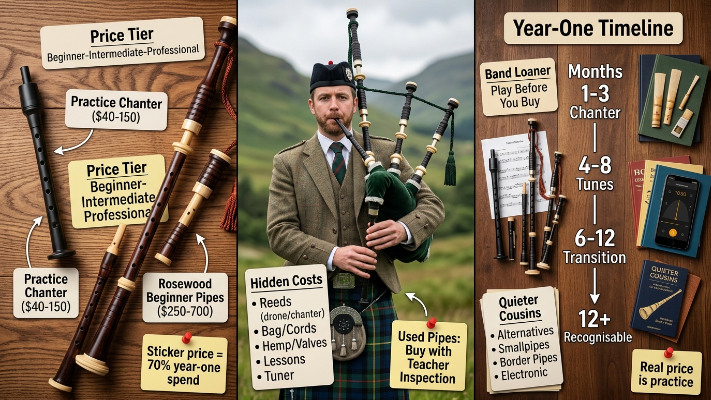
Start here: the practice chanter ($40–$150)
Nobody learns on a full set of pipes. Every piper — from first-timer to world championship soloist — starts and stays with the practice chanter: a simple, quiet, recorder-like instrument with the same fingering as the pipe chanter. You’ll spend your first six to twelve months on it exclusively, learning the scale, the grace notes, and the embellishments that make pipe music what it is.
Plastic (polypenco) chanters run $40–$80 and are honestly ideal — durable, stable, and what most instructors recommend. Wooden chanters in rosewood or cocuswood cost $80–$150, feel warmer in the hands, and sound mellower. Either way, this is the best $100 or less you’ll spend in piping, and if the hobby doesn’t stick, it’s a cheap discovery.
Beginner Highland pipes ($250–$700)
This tier is dominated by pipes made from rosewood, sheesham, or cocuswood — dense hardwoods turned in Pakistan’s Sialkot region, which has manufactured bagpipes for over a century. Reviewers are snobbish about this tier, sometimes fairly (avoid the $100 eBay “decorative” sets, which genuinely cannot be tuned) and sometimes not: a properly made rosewood set with quality reeds and a decent bag is a legitimate learning instrument that will carry a student two or three years.
What to check at this price: synthetic drone reeds included (cane reeds frustrate beginners), a real hide or hybrid bag rather than vinyl, and a seller who actually plays. Sets from specialist retailers — the bagpipes carried by kilt and piping shops, for example — are set up to be playable out of the box, which the mystery-marketplace sets never are.
Intermediate ($800–$1,800)
Here you enter African blackwood territory — the dense, oily tonewood that professional pipes are made from — usually from established Scottish, Canadian, or Pakistani workshops’ mid lines. The sound difference is real: steadier drones, a brighter chanter, better tuning stability across temperature. This is the “one and done” tier for a serious hobbyist; many pipers never need more.
Professional ($2,000–$7,000+)
Full blackwood, silver or imitation-silver ferrules and mounts, hand-finished bores, and names with waiting lists. What the money buys at the top end is partly tone, partly tuning precision, and partly ornamentation — engraved silver and ivory-substitute mounts can double a set’s price without changing its sound. Competition players and pipe bands live here. Beginners should not.
The costs nobody quotes you
The sticker price is maybe 70% of year-one spending. Budget for:
- Reeds:pipe chanter reeds ($15–$30) are consumables; drone reed sets ($80–$150) last longer. Expect to experiment.
- Bag cover and cords:often included, not always ($40–$100).
- Hemp, valves, seasoning, maintenance kit:$30–$60 of small essentials.
- Lessons:the big one. $25–$60 per session, or free-to-cheap through many pipe bands — which is the best-kept secret in the piping world. Bands want learners and often teach beginners at no cost in exchange for eventual membership.
- A tuner and metronome app:free to $20, non-negotiable.
Used pipes: bargain or trap?
Both. Quality blackwood pipes hold value for decades, and a used set from a known maker at 60% of new price is the best deal in piping. But old pipes can hide cracked wood, rotted bags, and worn bores that cost hundreds to restore. The rule: buy used only with a teacher or experienced piper inspecting, or from a dealer who’s overhauled the set. Never buy antique “attic pipes” to learn on.
So what should a beginner actually spend?
The consensus path: $60 practice chanter now, then $300–$600 on a starter set six months later once your teacher confirms you’re ready — roughly $500 in year one including basic lessons through a band. That’s less than a beginner guitar-and-amp habit, for an instrument considerably harder to put down.
Specialist shops that serve the Highland-wear world, like Scottish Kilt, typically sell chanters, starter sets, and the consumables in one place, which spares a beginner the fifteen-tab research spiral that this hobby otherwise induces.
The quieter cousins – smallpipes, Border pipes, and electronic chanters
“Bagpipes” almost always means the Great Highland bagpipe, but the family is wider — and for some learners, a cousin is the smarter first instrument.
Scottish smallpipes ($600–$2,000) are bellows-blown, parlour-volume, and sweet-toned — the pipes you can practise in an apartment without a neighbourhood incident. Same nine-note scale and fingering as the Highland pipes, so skills transfer directly. Many adult learners now run both: smallpipes for home, Highland pipes for outside.
Border pipes ($900–$2,500) sit between the two — bellows-blown but brighter and louder than smallpipes, favoured in folk sessions where fiddles and guitars need a pipe that blends rather than bulldozes.
Irish uilleann pipes are the beautiful outlier: two-octave range, regulators, extraordinary music — and famously the hardest of the family to learn and maintain, with prices and waiting lists to match. Fall in love with them knowingly.
Electronic chanters and pipes ($150–$500) deserve more respect than purists give them: headphone practice, built-in tuning, recording output, and silent hotel-room rehearsal. As a supplement to — not replacement for — a real chanter, they solve the piper’s eternal problem, which is that the instrument’s volume is a scheduling constraint.
The practical takeaway: if your living situation can’t absorb 100-plus decibels, budget for smallpipes or an electronic chanter alongside the Highland set rather than fighting your own practice schedule. The pipers who quit are overwhelmingly the ones who couldn’t find anywhere to practise.
What the first year actually looks like
Cost questions are really commitment questions, so here’s the honest timeline:
Months 1–3: chanter only. Scale, grace notes, and the first embellishments — doublings, throws, grips. Fifteen focused minutes daily beats an hour on Sundays; finger memory is a compound-interest asset.
Months 4–8: first tunes, still on the chanter. Every piper alive started with the same handful of marches and slow airs. This is also when you join a band’s learner programme if you haven’t — the structure roughly doubles progression speed.
Months 6–12: the transition. Onto the full pipes in stages — blowing the bag steady with corks in the drones, then one drone, then all three. Expect to feel like a beginner again for a month; the instrument demands breath, posture, and squeeze coordination the chanter never asked for. This is precisely when the quality of your starter set matters — an airtight bag and stable synthetic drone reeds are the difference between a hard month and a miserable one.
Month 12 and beyond: playing recognisable tunes, on real pipes, adequately — which, given the instrument’s reputation, is a genuine achievement. First public performances (parades, Burns suppers, one extremely patient family gathering) typically land in year two.
Budget the year, not the purchase: chanter now, lessons throughout, pipes at the halfway mark, consumables always. Spread that way, the world’s most dramatic instrument costs about what a gym membership does — and unlike the gym, nobody ever forgets you play it.
Before you buy at all: loaners, rentals, and the band route
There’s a stage-zero option this whole breakdown has been circling: don’t buy the pipes yet. Many pipe bands maintain loaner sets precisely for students transitioning off the chanter — a season on band pipes costs nothing, teaches you what a properly set-up instrument feels like, and turns your eventual purchase from a guess into an informed choice. Some teachers and piping schools run the same scheme, and short-term rentals exist in most piping cities for exactly this transition window.
The loaner route has a second, underrated benefit: calibration. After six months on a decent borrowed set, you’ll pick up a bargain-bin instrument in a shop and feel the leaky bag and unsteady drones within a minute — a discernment no review video can install. The pipers who buy well are almost always the ones who played someone else’s pipes first.
If no band or loaner exists within reach, the sequence earlier in this article stands — chanter, then a properly set-up starter set — but ask every seller one filtering question: “who sets up and tests these before shipping?” The answer separates instrument dealers from box-shifters faster than any price comparison.
The honest last word
Bagpipes cost whatever tier you buy into — but the real price of piping is the practice. A $400 set played daily will embarrass a $4,000 set played monthly, every single time. Buy the chanter, find a band, and let your progress tell you when the wallet opens next. The pipes have waited several centuries for you already; they can wait six more months while you earn them.